By Spc. Opal Vaughn
14th Public Affairs Detachment
"Okay stop," says Navy Lt. Chris Hussey, a platoon officer with Explosive Ordnance Disposal, Mobiet 1, based out of San Diego, Calif., as he walks through a set of t-wall barriers, which compose the entrance of a House-Borne Improvised Explosive Device training site. "What did you guys do wrong?" Hussey asks a group of Soldiers he's training.
Hussey looks around and smiles seeing no one raising a hand to answer his question. Slowly he crouches down on one knee, "You see this?" he points to what looks like an ant trail but to the Soldiers surprise, a wire protrudes at the end of the trail. "These are the kind of mistakes that get people killed and that is why I am going to train you guys on what to look for and how to clear a house properly."
"Now line back up and let's try this again, step by step," Hussey grins.
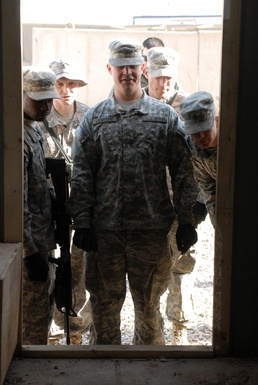
And just as quickly as the command is given, the Soldiers quickly set back up behind the barriers to start the Level 1 class on HBIEDs while at Forward Operating Base Warhorse, Jan. 9.
"Typically we train coalition forces here at Warhorse or within our area of operation," said Hussey. "But we have been starting to integrate the Iraqi army into our training as well."
"HBIEDs and booby trapped buildings have been a pretty decent threat out here; we've had a few casualties," Hussey stated. "We've created this training to give some safe tools to the Soldiers so that they can stay safe and be confident in what they've learned."
The HBIED training site is composed of a wood house and several CONEXs converted into buildings. Each room is booby trapped with different scenarios which are realistic to what a Soldier might see when out in the field, according to Hussey.
"We try to keep things pretty realistic to the devices that are found in our AO," Hussey explained while pointing out different places where IEDs could be hidden in the walls of the house at the training site. "Simple things like victim-operated devices such as crush wire, IEDs, trip wires in doorways, anti-personnel landmines and command wire IEDs. They are all pretty basic and things the Soldiers can identify and learn proper safety procedures to work around them," Hussey stated.
"They are devices we've recovered from the field; things we've built up that are simulations of devices that are actually out there," Hussey said, walking toward the next training station.
"Make sure you guys communicate with each other. There's no since in trying to clear something by yourself. You have to work together as a team," Hussey shouts to the Soldiers.
Hiding himself inside a room of one of the houses, Hussey continued to explain, "Prior to even touching a house, do a 360 degree reconnaissance around the outside. Get any type of information you can gather on the house by looking inside windows, looking outside and around the house, look above the house, look for anything that may look suspicious, anything out of the ordinary like piles of brush in the doorway, command wire routed along the ground and through windows, entry and exit access to the house; these are all key factors to look for," Hussey stated.
"Seeing inside those windows is really important to see if you can identify any type of hazards inside or any type of unknown materials that you can check out once you enter the house," Hussey said. "But if you identify these threats prior to entering the house, you've mitigated an extensive amount of risk prior to entering it."
"Shhh, here they come," Hussey grinned as he crouched lower in his hiding spot.
After about ten minutes of waiting, Hussey finally popped out of his hiding position. "Now, if I were an insurgent, you guys would be done," Hussey looks at the Soldiers. "You must ensure to check everything, even if it's something as simple as knocking on wood," Hussey tapped on the wall with his hand.
Even though Navy EOD offers two levels of HBIED classes, Hussey integrates techniques from both classes into his training to better prepare the Soldiers.
"We teach two levels; level one is simple recognition of the threats and going through techniques to teach the Soldiers to be safe. Level two is more identifying the threats as soon as possible and taking appropriate measures like knowing when to call EOD for help," Hussey said leaving the training site. "Also, knowing what things you can identify and clear without our help."
Hussey continued his class outside the barriers, "There's a lot of trash in these houses, well, in Iraq in general. We want to help give you guys the confidence to interrogate those threats and the potential unknowns; clearing something and identifying something or if it is what it is, garbage."
Ending the class with time for questions, Hussey thanked the Soldiers for coming out and talked for a minute about some of his own personal experiences.
"We conduct route clearance operations all throughout the surrounding areas," said 1st Lt. Joel Groves with 2nd Platoon, 87th Engineers Company, 5-55th Engineer Brigade, also known as "Triple Nickel."
Taking a minute to check on his Soldiers trying to clear a room in a booby-trapped house, Groves continued, "I felt it would be beneficial for both my platoon and for our engineer company to take this class. It will help us to gain the situational awareness of some of the HBIEDs in our area of operations and allow my Soldiers to see firsthand, the threat that surrounds them and give them an idea of the types of IEDs that are not just on the roads."
"I really appreciate the EOD guys here," Groves stated. "They've taught a great deal on HBIEDs and this is some really great hands on training they offer us here."