By Sgt. David Turner
4th Brigade Combat Team, 3rd Infantry Division
FORWARD OPERATING BASE KALSU, Iraq – Staff Sgt. David Vasquez begins this chilly December day as he has many others during his past 14 months in Iraq: Driving around looking for improvised explosive devices. Just before sunup, he and other members of Co. E, 2nd Platoon, 3rd Battalion, 7th Infantry Regiment, meet near their array of specialized vehicles for a mission brief. Maps are spread out and tactics are discussed, though, one thing is different about today: Most of the team members heading out to perform this route clearance mission are Echo Company's replacements, Soldiers from Co. A, 9th Engineer Battalion.
As the Soldiers of Echo Co., 3-7th Inf. Regt. prepare to redeploy home to Fort Stewart, Ga., along with the rest of the 4th Brigade Combat Team, 3rd Infantry Division, they are also busy training the new Soldiers, part of the 172nd Infantry Brigade, how to find and defeat improvised explosive devices, something they have become proficient in during their nearly 15-month tour.
"For the past three days they've been riding with us and today is their first mission with them in the lead," explains 1st Lt. Glenn Frost, 2nd Platoon leader. "They're pretty much running the show now."
During the first week of the transition, the new Soldiers experienced the "right-seat ride," by watching and learning. Now they are literally in the left seat, driving a strange-looking convoy of vehicles along unfamiliar roads, looking for trouble.
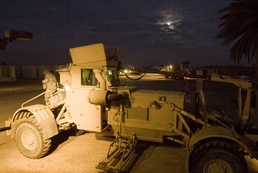
Vasquez, a soft-spoken engineer from Miami with Echo Co., rides in the "Buffalo," a heavily armored vehicle with an articulated arm for "interrogating" suspicious roadside objects. There is also a bomb robot stowed onboard, just in case. Vasquez rides in the back seat, occasionally giving advice to his counterpart, Staff Sgt. Kevin Hastings.
Route clearance, he explains, is a constant operation, involving some high-tech equipment, plus a lot of observation and common sense. Keeping supply routes clear and convoys safe from IED attacks means knowing your surroundings and noticing small differences, he says. During the past 14 months, Vasquez and his team have become familiar with these roads, which take them all over the Vanguard area of operations. He points out which areas are "hot spots" – known areas of IED emplacement – and what things to pay attention to.
"These are the [techniques and tactics] we've been using the whole time. It's always important to teach the incoming unit what's going on and inform them about the area and the local population. The things we've been teaching them have helped them especially on these routes, where you find a lot of trash along the side of the roads," says Vasquez.
Roadside trash and debris is an ever-present feature here, even in areas where the economy is improving and new construction projects are on the rise. At several points along the way, Soldiers stop to check out a suspicious object; a box which may or may not be empty, a plastic bag that appears to be weighted down. Disguising IEDs among the roadside clutter is a frequent tactic of IED-placing cells.
Once during his tour, Vasquez discovered an especially deadly IED disguised with sprayed-on foam to resemble a large brick. His team was travelling back to Forward Operating Base Kalsu on Route Jackson, a heavily-travelled supply route.
"We had gone down to Patrol Base Hilla, so I'm guessing they had set it in place for us when we were heading back north. The way I saw it was it looked totally different from anything I'd seen before; it looked very suspicious," says Vasquez.
It turned out to be an array of three explosively formed projectiles, a device capable of penetrating some armored vehicles. Though IED attacks have been declining in recent months, some tactics have changed, and the hot spots have shifted to less-traveled routes.
"It's gotten extremely better – it's night and day between from when we got here and now," says Frost. "Most recently it's been more of the EFP threat down south, toward Hilla. Prior to that, it was a big threat with an al-Qaida cell out west."
When the 4th BCT arrived here in October 2007, troops in the area had already done much of the work to clear routes in the area south of Baghdad, once an al-Qaida haven. As counterinsurgency efforts began to draw more support from the local population, and with help from the Sons of Iraq, coalition forces were able to discover and defeat many IEDs before they struck. Some were massive, deep-buried IEDs, placed long ago, waiting to be detonated. With al-Qaida largely driven out of the area, the threat came more in the form of radical militias and EFPs. Responding to new threats, says Frost, means a constant exercising of fundamental route-clearance skills.
"We've got a lot of technology that helps us identify and defeat IEDs, but the biggest thing is speed. If they stay slow, the best way to prevent an IED strike is to see it first," says Frost, a native of Murfreesboro, Tenn.
He advises the new Soldiers to investigate anything that looks suspicious. Attention to detail has served his Soldiers well. 2nd platoon has found 32 unexploded IEDs in the past 14 months, and Echo Company has cleared almost 100, he says.
There are several roadside stalls and businesses that are busy with people at mid-morning.
Coalition convoys have become so commonplace here that people barely seem to notice them. At points along the way children stop to wave. While they are stopped, cars cross the median of the highway, into oncoming traffic, to go around the convoy.
The warning icon indicates this is another hot spot. However, there is nothing to investigate, so the convoy presses on. A little farther up, Hastings notices something sticking out of a culvert beside the road.
"It looks like a bag with something in it," says Hastings.
"Roger," says Vasquez. "We've checked it out before, but if you want to check it out [again], go ahead."
Hastings deploys the Buffalo's arm to "interrogate" the object. Safely inside the cab, he uses a joystick to manipulate the arm, getting a closer look on a video screen via a camera mounted on the arm. At the end of the arm are several long tines.
"It's basically poking it with the arm, making sure it's all clear," says Vasquez. It turns out the object is just a bag weighted down with tar. After folding up the arm, the convoy moves on. Although Vasquez has spotted the same object before, he figures it's best for the new team to practice vigilance and learn for themselves.
"I've been here for quite some time, so I can more or less tell what looks suspicious or not. These guys don't know that yet. They have to get familiarized with the routes and what they see out there," he says.
When they return to the FOB, the new Soldiers seem pleased that their first day on the job went by without incident. Shutting off the Buffalo's engine, Washington takes off his helmet and smiles.
"Boring is always good," he says.