By Pfc. Lyndsey Dransfield
Multi-National Division - Baghdad
CAMP LIBERTY, Iraq – Iraqi security forces have once again taken an enormous step forward in becoming more self-sufficient by securing supplies and equipment it needs to sustain continual operations as a viable organization.
And helping the ISF attain this self-sufficient status are the Soldiers of Multi-National Division – Baghdad's ISF Logistics Cell, who are providing assistance in advancing the ISF's logistics efforts, which further enhances its capability to perform missions on a daily basis.
Throughout the past five years, Iraqi army logistics has struggled to make ends meet for its Soldiers. One of the crucial issues facing the ISF involved obtaining spare parts for its humvees, which are the primary vehicles used by Iraqi Army soldiers on their daily missions.
"Class nine spare parts has been considered one of the primary inhibitors to logistics and supply," said Maj. John Joseph, a native of Canton Ga., officer in charge of G-4 Logistics, Iraqi security forces Cell, 4th Infantry Division, MND-B. "It became such an inhibitor that it was an issue brought up in every meeting we went to. It was keeping them off the road from successfully conducting current operations."
Spare part deficiency was not the issue. The parts had been ordered and received by the Iraqi army, but there was no distribution plan to get them down to the battalion and brigade levels.
"There was a bunch of spare parts sitting unorganized in a warehouse in Taji," said Joseph.
In September, the Iraqi ministry of defense, along with Multi-National Security Force – Iraq, Coalition Army Advisory Team and division military police transition teams developed the Iraqi Army Class 9 Spare Parts push package program, where they organized all the spare parts, put them into packages and distributed them to the 6th, 9th, 11th and 14th IA Divisions in Baghdad.
The divisions then developed their own plans to distribute them to the brigade and battalion levels, explained Joseph.
Joseph, along with Maj. Shane Upton, a Bloomington, Ill. native, who serves as the assistant officer in charge of the ISF Logistics Cell, has been monitoring the implementation of the program from the beginning and will see it through its completion at the end of December.
"This is a true test of the Iraqi army logistics system and the capabilities of the headquarter support companies," said Joseph.
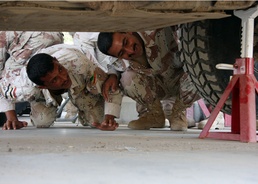
Many Iraqi army soldiers were trained by military police transition teams as mechanics, but the lack of parts has prevented them from putting their training to use. Now that the parts are being distributed, mechanics can be pulled from checkpoints and do what they were trained to do – fix vehicles, he explained.
"The Iraqi logistics system now has a chance to work for itself, which is our goal."
Although coalition forces played an imperative role in the execution of the program, the Iraqi security forces are the ones responsible for the progress, said Joseph.
"We are here to help them execute their system," he said. "We're not here to redesign it or change it in anyway. Their system is centralized because it is culturally based and it's how the Iraqi army functions."
In 2005 and 2006, coalition forces began implementing the United States' systems to improve the infrastructure of Iraq.
"Doing things our way was quickly proven to be an unsuccessful endeavor, said Joseph. "They [Iraqis] wouldn't execute our system unless we were hand-in-hand with them."
When coalition force leaders realized the plan wasn't working, they quickly changed their actions to support the Iraqi system by providing resources and provoking actions to occur, explained Joseph.
"It is not up to us to do it for them or dictate how their system should work," he said. "We show them some methods; it may not be methods they adopt. but they're methods that work for us. They can take the best practice out of that and apply it if and how they want."
They key, however, was to let them figure out how to make the system work and to provide assistance where needed.
"Our effort didn't change anything about their system," said Upton. "It just promoted their system by helping them push the packages down to those who need them."
Due to the progress of the push package program, MND-B's G4, ISF Logistics Cell, plans to launch a similar program for Iraqi National Police in the near future, explained Upton.
"The police force also has non-tactical vehicles that they use to complete their missions. These parts are in their warehouse and need to be organized. This isn't a one-time deal. The program is proven to be effective and will be used throughout the future."