By Staff Sgt. Scott Wolfe
2nd Brigade Combat Team, 1st Armored Division
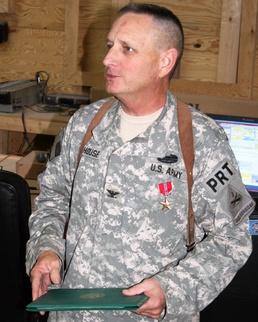
BAGHDAD – Col. Roy House has spent the past 18 months in Iraq assisting the Iraqi judiciary in the administration of juvenile justice. As an Army lawyer, he was assigned the task of mentoring and encouraging officials of the Republic of Iraq's juvenile police, juvenile courts and juvenile rehabilitation institutions.
Now, instead of dodging roadside improvised explosive devices on his frequent visits to the Iraqi Court House, he is retiring to his home in Searcy, Ark., where he will get reacquainted with his family and return to his private law practice.
"I've been in for 38 years," said the Arkansas Guardsman, with a sad note to his voice, as he speaks about his impending retirement in January. "I get to sow the seeds that someone else will reap."
A member of the Arkansas National Guard, he volunteered 12 times before he was mobilized for Iraq, where he was assigned to the 3rd Infantry Division, Multi-National Division – Center, in June 2007.
Because of his background in civil and governmental practice of law, House was further assigned to the Department of State's Baghdad Provincial Reconstruction Team. His task was to assist the Iraqi judiciary in the administration of juvenile justice.
"He is a good man with a big heart," said Richard Hawkins, his former supervisor, ebmbedded- Provincial Reconstruction Team 4 team leader for the Mada'in and Muhmudiyah Qadas.
He became so engrossed in his work that he decided to extend his 12-month tour to 18 months.
"He did not need to stay here," said Hawkins. "He had fulfilled his obligations. He stayed here because he felt that strongly about what he was doing."
Out of all the developments and initiatives he worked on, House said he is most proud of two projects he helped bring to the Iraqi people. He enlisted the help of Iraqi lawyers in educating citizens about the Rule of Law – something some Americans may take for granted but is foreign to Iraqis. He also helped educate Iraqi citizens on the privilege of voting and how they can now decide who will lead them.
He also assisted in the creation of a non-governmental organization that would pay private attorneys to write articles in the local newspapers explaining subjects such as democracy, human rights and the functions of government.
The program allows the typical Iraqi citizen, who has never had a civics lesson, to gain knowledge of how their new government worked and how to participate it its growth.
"It was 100% his idea," said Hawkins, referring to House. "He found the guys who would do it; he helped create the NGO – $200 is not a lot of money, but it is an incentive. From there, professional pride took over and now well over a dozen articles and more are published every week."
House said he had his most memorable moment while on a routine patrol to an Iraqi court house in April 2008 when his convoy came under enemy fire. His actions that day earned him a Combat Action Badge.
That same month, he joined the 2nd Brigade Combat Team, 1st Armored Division, when it replaced the 3rd Heavy Brigade Combat Team, 3rd Infantry Division, in the Mada'in Qada.
He spoke of the Iron Brigade with fondness and respect.
"They think further down the road. They are used to thinking ahead," he said as he paused, searching for the right words. "I think it is because they are used to thinking about consequences. I think it is because armor moves down the road at 20-30 mph, and they have to think about what happens further down."
House would also be awarded the Bronze Star for his exceptionally meritorious service as the Rule of Law Advisor while deployed to Iraq. For himself, however, he said the deployment was always about his passion for the law and the Iraqi juvenile justice system. He witnessed and reported on deplorable conditions of juveniles in the Iraqi court system to his superiors and to Iraqi judges. He was permitted to enlist the assistance of the United Nations Children's Fund (formerly UNICEF) and the International Committee of the Red Cross to improve the conditions.
"Seeing human beings in these conditions would make you cry," said House, who was also a former juvenile judge. "No one would allow animals to live in such deplorable conditions in America."
House arranged a meeting in Amman, Jordan, with the organizations and 30 Iraqi judges, lawyers and senior government officials responsible for juvenile justice. As a result of the meeting, the UN and other international organizations focused attention and provided assistance to Iraq's juvenile justice system.
As a result of their combined efforts, Iraq's juvenile delinquent and neglected children receive much improved care.
"The Iraqi judges are pretty good," he said, speaking with a soft, southern drawl that soothes and relaxes. "There is nothing wrong with their judges. I have never heard of them breaking the law or taking a bribe. I have a lot of confidence in their Judiciary."
The Rule of Law advisor to the Iron Brigade also rounded up another body of people to educate Iraq's future when he helped to establish the second NGO to hire educators, teachers and administrators that would eventually develop a civics education curriculum to be tested in the Mada'in Qada.
Roughly the equivalent size of Washington, D.C., the Mada'in is a microcosm of Iraq and the perfect choice for curriculum all of Iraq will ultimately adopt, he said. The course includes a 30-minute civics lesson in each class, at each grade level, each week throughout the school year. It is backed by Iraq's Ministries of Education and Human Rights as well as the United States' State Department.
House spoke at length of his favorite accomplishments in Iraq, clearly excited about his time spent here. He was subdued though, when he talked about his tour coming to an end.
During his time in the military, he said he remembers the people and units more than the things that happened.
"I have worked with the 82nd, 101st, 1st ID, 3rd ID ... they are a professional group of people," he said.
But for now, he said he is looking forward to returning to his family in Searcy and starting his private law practice in January.
"I might go back to Iraq," he said, after talking about what he might miss when he gets back to the United States. He started to chuckle, his accent coming out stronger in his mirth.
"I am an adopted member of the Borjet tribe," exclaimed House, "so I have family out here. I have a 'nephew' now that is as old as I am."
His laughter finally receded and he became serious again.
"Really, they are a great people, and I love them. I just wish I had been able to do more – Maybe I will go back."