By Kiyoshi Freeman
3rd Sustainment Command (Expeditionary)
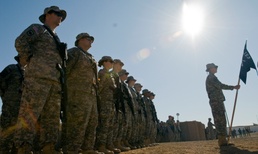
AL ASAD AIR BASE, Iraq – Arkansas National Guardsmen cased their colors and handed over their mission to a unit from Texas during a transfer of authority ceremony Dec. 4.
The 2nd Battalion, 153rd Infantry Regiment escorted convoys – primarily fuel trucks from the Jordanian border through Anbar province. More than 40,000 trucks carrying over 99 million gallons of JP8 (high grade jet fuel), almost seven million tons of diesel fuel and other mission-essential supplies were escorted to hubs like Al Asad.
"If it went in their bellies or in their [fuel] tanks, we brought it in from the border for them," said Lt. Col. John Stewart, the commanding officer of 2nd Bn., 153rd Inf. Regt., from Searcy, Ark. "For nine months we sustained the service members of the Multi-National Forces-West," he said, referring to all of Anbar province.
The 2nd Bn., 153rd Inf. Regt., was replaced by 2nd Battalion, 142nd Infantry Regiment of the Texas National Guard.
Preparations began months ago for this moment, almost immediately after the 2nd Bn., 153rd Inf. Regt., completed their own transition, said Command Sergeant Major Philip Johnson from Little Rock, Ark., the battalion command sergeant major of the 2nd Bn., 153rd inf. Regt. "You always go through a challenge when you go through a relief in place, no matter who you're replacing," Johnson said. "We wanted to improve the foxhole for the next guy."
Those improvements included making additions to the motor pool and workspaces; servicing and maintaining military vehicles which travelled a total of over 2.6 million miles; securing non-tactical vehicles and bus contracts, housing, and a myriad of other details so their relief, the 2-142nd, could hit the ground running, he said.
"The 2nd Bn., 153rd Inf. Regt. really set us up for success," said Lt. Col. Mark Burkett from Canyon, Texas and the commanding officer of 2nd Bn., 142nd Inf. Regt. "They definitely took those additional steps that will make us successful."
The 2nd Bn., 153rd Inf. Regt had to overcome several obstacles when they first began their deployment
"The initial challenge was just trying to equip each of the four line companies," Stewart said, and that the battalion had on only half of the equipment they needed to accomplish their mission. More vehicles were eventually brought in to bring the unit up to strength.
Another challenge was getting an adequate number of personnel, he said. Soldiers from their support battalion were used as fillers.
"I've got an x-ray technician that's a .50-caliber gunner," Stewart said with a smile. "He went to school for 52 weeks to be an Army x-ray technician, and he ran a .50-cal. machine gun for nine months out here."
The four to six-day missions could be tedious at times, but the supplies were essential, said Sgt. John Smith from Havelock, N.C., and a team commander with the 2nd Bn., 153rd Inf. Regt. The unit, though, would come together in the face of adversity, reacting to the few roadside bombs they encountered, or keeping each other alert on the road.
"When things happened," he said, "we always pulled together."
"I want to commend my Soldiers and the junior leadership here on the ground for the great things they accomplished," Johnson said. "As far as the amount of equipment and supplies we hauled in here to Iraq, and the number of miles driven and vehicles escorted – truly a fantastic job."