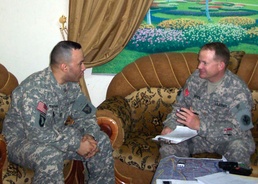
By Spc. Douglas York
Multi-National Division - Baghdad
CAMP LIBERTY, Iraq – In turn an old moniker states that 'those who don't learn from those mistakes are doomed to relive them.'
Keeping that thought in mind there are Soldiers within the Army who try to prevent history from repeating itself, while simultaneously ensuring remarkable people and events are remembered.
"It is one of the most important jobs in the Army," said Spc. Teri Bupp, a native of Roxbury, Kan., who is currently serving as the administrative specialist for the Army Reserve's 101st Military History Detachment out of Wichita, Kan. "We have to learn from our mistakes and we have to remember the Soldiers that have given their lives here."
"I really like being a part of that; being able to help people remember that," she added.
Bupp is part of a three-Soldier unit that provides military history collection support to Army units. Currently, she and her fellow combat historians provide that support to the 4th Infantry Division and Multi-National Division – Baghdad.
"Anybody who has anything to do with 4th Inf. Div. we cover down on them and we collect their history; what they did, while they are here," said Sgt. 1st Class Kristina Scott, a native of Lincoln, Neb., who serves as the 101st MHD's non-commissioned officer in charge
"Kinetic and non-kinetic, anything they've done," Bupp added. "We collect it and send it off to writers that write about what they [the various Ironhorse units] have done."
She continued stating that in addition to conducting oral interviews, they collect documents, photographs, videos and artifacts in order to aid in writing the Army's official history.
Amongst the obscure objects or artifacts this trio and previous MND-B MHDs have collected are: confiscated enemy weapons, uniforms from Soldiers that have been involved in firefights, lighters or matchbooks with 'wanted' posters and telephone-tip-lines on them and oddly enough water bottles.
Moreover, they are looking to acquire a commonly used warning sign (written in Arabic), which asks the local national people to 'stay back 100 meters' from military vehicles and checkpoints, as well as a Soldier's personal journal documenting his or her time over here; provided he or she would be willing to part with it.
The collected items are then cataloged, linked to specific significant events, which the 101st MHD identifies for the collected time period. The items are then sent to the Army's Center of Military History at Fort McNair, Washington, D.C., where they are stored in a secret vault. However, Bupp says it all begins with interviewing the troops.
"The 'meat and potatoes' of what we do is, we go around and we interview Soldiers," Bupp said. "We ask them what they've done and a lot of times; in my lane, they will give me the lower enlisted [Soldiers] that have received awards for certain things they've done."
She also added that in addition to the Soldier's accomplishments the MHD documents any combat action the troops have endured.
When they are not collecting information and various objects from the Soldiers; during their missions, the unit has several other more defined tasks to accomplish.
"We have a specific mission, we're tasked with specific criteria such as AARs [After Action Reviews], SITREPs [Situation Reports] and casualty reports," Scott said. "Some people might not think to collect those things, but we're here to make sure that it gets collected."
Scott explains however that there is a method behind the seeming madness for collecting these types of documents.
"Too often people don't think about writing stuff down, about collecting, about preserving and so it gets lost," she said of the potentially historic things that Soldiers and their units might overlook. "So, we're here to make sure that it doesn't."
The unit's commander, Maj. Dave Spies agrees with his team's NCOIC, but also looks at their mission from a different angle.
"The uniqueness of being in the 'history-business' is that you get out and about and see many different people and units and you get exposed to a lot of things," the native of Saint Peters, Mo., said. "That's what makes this a special job."
As with any 'special' job the MHD has many behind the scenes things that must transpire, before and after they fall in on a unit and begin documenting what that unit has done or is currently doing.
"We spend a lot of time on the computer digging up documents [i.e., AARs and SITREPS] that we consider important, anything that will back up what we've been told in interviews with Soldiers," Bupp said. "We tend to do that before we go out to cover down on a unit; we'll data mine and look up everything we can on them and find out what they do."
Bupp continued saying that one or all three of them will go out for three or four days to a forward operating base or a joint security station and spend that time getting their goal of 10 interviews per company. Once on site Bupp will usually interview all the enlisted Soldiers from staff sergeant down to private. Scott handles the interviews with enlisted Soldiers above the rank of Staff Sgt. and Spies conducts the interviews with the officers.
"We tend to go out quite often and then when we come back we enter all of the data that we've collected in a database specific for MHD's called MHCSI [Military History Collection System Integrator / cataloguing software]," Bupp said. "That [information] goes into a database at which point; once we're done collecting, we load it all on to a hard drive, send the artifacts to Anniston Army Depot, Ala. and then start all over again."
She also elaborated that they send the information about every six months and that when the Ironhorse Division leaves in early 2009, they will remain behind and start from scratch when the 1st Cavalry Division takes over the MND-B theater.