By Staff Sgt. James Hunter
2nd Brigade Combat Team, 101st Airborne Division, Public Affairs Office
BAGHDAD – When Multi-National Division -Baghdad Soldiers with Battery B, 1st Battalion, 320th Field Artillery Regiment, first arrived to Iraq more than a year ago, they would take on a mission that they would describe as an "adventure."
The battery troops would patrol Rathwaniyah and not to just simply secure the local populace but help build the economy and essential services within.
Everything would hinge on security; once the locals felt secured, they would be able to work on aiding the community.
"I don't think anyone fully realized we were going to be performing the tasks we were asked to do," said Capt. Geoffrey Gorsuch, commander, Btry. B, 1st Bn., 320th FA Regt., 2nd Brigade Combat Team, 101st Airborne Division (Air Assault). "On top of our everyday security missions, the battery leadership ended up helping school administrators, water engineers, electrical engineers, family feuds and local councils."
The unit before them did a great job working with the locals to secure the area, which has since been fairly secure, said Gorsuch. There were very few attacks within their area, so they decided to focus on improving quality of life and essential services.
One of the biggest problems they would have to solve was the poor irrigation system and the lack of running water.
"We were able to get the drinking water running for the first time in five years and also made improvements to the water canal system that provided irrigation water to over forty farms that have received very little water in the last five years," said Gorsuch. "We also focused our efforts on providing work and projects that would have a lasting effect on the community. We have provided over five-hundred jobs to locals living and working in the community."
All the battery's projects focused strictly on essential services within the area, said Gorsuch. They were able to build three water potable water stations, fix the existing potable water pipes running into their area, fix the irrigation canal system and complete micro-grant applications for local farmers to buy green houses to extend their growing seasons.
Gorsuch said they were also able to build a veterinary clinic for the local veterinarian to work out of.
"We completed all major projects in the area and left ideas for the incoming unit on what types of projects would be good in the area," said Gorsuch. "I knew we succeeded when one of the local sheiks asked the incoming unit to help build an internet cafe. This showed me that the locals were satisfied with the ESS in the area and were now focusing on quality of life."
One of the most contributing factors to success with the projects and security within the region was their extended relationship with the local leaders.
"We have built lasting relationships with the local sheiks, families and people in the area," said Gorsuch. "The platoon leaders and myself met with locals on a weekly basis to discuss ongoing issues and concerns of local nationals."
He even encouraged his Soldiers to interact with locals as often as they could.
"I believe this really helped build the trust of the local nationals. Locals would nickname Soldiers they talked to and always ask patrols where their [coalition forces] friends were at if they were not on patrol," said Gorsuch. "This helped build a personal relationship with my unit and the LNs. Eventually, the locals cared about our safety as much as their own. This was demonstrated at least twice when local nationals pointed out improvised-explosive devices to our patrols before the vehicles traveled down the road."
Gorsuch is extremely proud of his Soldiers and their performance over the last year.
"I could not dream of a better group of men," he said. "They consistently amazed me with their professionalism and dedication the mission. Nothing we accomplished would have been possible if the Soldiers did not believe in the mission they were performing. They can truly be proud of the work they did in the area and they can be sure they left our little corner of Iraq safer than when we arrived."
Now it will be up to the Soldiers of Battery B, 1st Battalion, 7th Field Artillery Regiment, 2nd Heavy Brigade Combat Team, 1st Infantry Division, to continue the successes of the Top Gun troops.
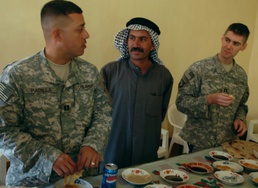
Capt. Steve Padilla, the battery's commander, said he sees a very pro-coalition forces area where agriculture is the main way of making a living.
"As we conducted our first operation, a combined medical operation, it gave us the opportunity to meet and greet the local people," said Padilla. "The Soldiers had the opportunity to interact with the local nationals and begin the process of forming a relationship with the local people."
And it is that relationship he said he plans to build upon.
"I plan to build a working relationship where we can see each other as business partners," he said. "We need to develop a relationship that is professional and aimed toward the common good."
That common good is a relationship based on mutual trust and understanding, Padilla added. They have the opportunity to grow, understanding the cooperative goal of improving the security and quality of life within the area.
"We will continue to work and finish the projects the Top Guns have initiated," he said. "Also, we would like to work to bring in other economic and agriculture programs. The focus of these other programs would allow the residents of our area of operations to explore the opportunity of exporting their goods around Iraq."
With all they plan to do and all the Top Guns have done over the last year, there are still some concerns.
Gorsuch said he believes one of the main difficulties First Lightning troops will face is balancing their operations with the transition to Iraqi security forces control.
"There is always going to be friction when different units come into the area. The locals in AO Top Guns are now so comfortable working with the U.S. Army, I think there maybe some apprehension about working with the Iraqi security forces," Gorsuch said. "We tried to involve the Iraqi army in most of our medical operations and [veterinarian operations] to begin to build trust between these two groups. If the new unit continues along this path, I think that the locals will slowly appreciate the professionalism of the new Iraqi army and police."
Padilla said he believes his Soldiers are very much ready for that.
"I see challenges just like any other operation the battery conducts," Padilla said. "One of the main mitigation factors is to utilize risk management. I want to give all my Soldiers the chance to integrate with the local nationals, so each and every one of them can form bonds.
"Additionally, another challenge is that all operations in the battery are decentralized," he continued. "With tough, competent small unit leadership, our junior leaders – at the squad leader and TC level – will know exactly what needs to happen at any given moment."
With their transition nearly completed, the Top Gun troops with Battery B will head back to Fort Campbell, Ky., knowing they accomplished a great deal while they patrols the streets of Iraq.