There were 4,591 unrestricted reports involving service members and 1,995 restricted reports in 2016, according to the 2016 SAPR report, found online at www.sapr.mil.
Service members can report a sexual assault as either unrestricted or restricted. An unrestricted report notifies the command and law enforcement as well as triggers health care and advocacy services for the victim. A restricted report remains confidential and lets a person access health care and advocacy services without notifying the command or law enforcement.
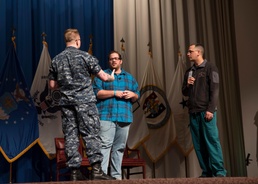
After witnessing a performance of a service member being ostracized and bullied for reporting a sexual assault, audience members were asked to chime in on ways to help the victim.
“Create a distraction,” or “Bring in help,” or “Go up the chain of command,” were some suggestions given.
Then those audience members were asked act out their examples on stage with a performance group, Pure Praxis, who had come to Naval Support Activity Bethesda (NSAB) and Walter Reed Bethesda, to provide sexual assault awareness training.
The scenes unfolded, giving service members a chance to practice personal engagement techniques that could help resolve a real life situation. The performance ended by suggesting statements that could be used to help survivors of sexual assault, such as “I believe you,” or “You’re not alone,” or “You’re stronger than you think you are.”
Pure Praxis, based out of Long Beach, California, has been performing at military bases since 2014 and comes to NSAB annually.
Benji Kaufman, a Pure Praxis actor, said the goal is to help people recognize situations and give them tools to help stop situations from escalating to violence and encourage support for survivors.
“By bringing service members on stage to actually try out their ideas creates a sense of accountability,” he said. “So when other service members see colleagues on stage being accountable, it builds the accountability within the command.”
Before bringing anyone to the stage, the performance group acted out scenes where one service member, who had reported a sexual assault, was experiencing retaliation by her peers. They also acted out a scene of a male service member struggling to report a sexual assault that happened to him prior to joining the military.
The Department of Defense Sexual Assault Prevention and Response (SAPR) 2016 annual report, www.sapr.mil, outlined ways the DOD worked to eliminate sexual assault from the military.
In 2016, the DOD worked on four key program efforts, according the report: Advancing sexual assault prevention, assuring a quality response to service members who report sexual assault, improving response to male service members who report sexual assault and combatting retaliation associated with sexual assault reporting.“We need to have this training because after all the years and effort and energy that our leaders have put forth in helping to eradicate sexual assault and sexual harassment in our military ranks, after all the efforts and training and energy we put into it; we still are missing the mark,” said NSAB Commanding Officer Capt. Marvin L. Jones.
The SAPR Victim Advocate 24/7 call line is 301-442-8225, and the SARC 24/7 call line is 301-442-2053. The DOD Safe Helpline for confidential victim assistance is 1-877-995-5427 or www.safehelpline.org.