By Staff Sgt. Brent Williams and Sgt. David Hodge
1st Brigade Combat Team, 4th Infantry Division, Multi-National Division-Baghdad
BAGHDAD – The Rashid Olympics in southern Baghdad came to as end as more than 330 teams from 14 neighborhoods competed in friendly soccer games spanning the course of the summer.
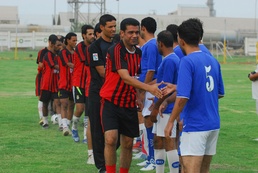
The Rashid District Sports and Youth Committee hosted the championship soccer match and closing ceremony Sept. 9, 2008 at the Jaza'ir Oil Refinery soccer field to pit the champions of the East and West Rashid beladiyats against each other in the contest to crown a winner and relish the success of the district's first sports program since the war began.
A team from eastern Rashid Abu T'shir earned a hard-fought 3-1 victory over the team from Risalah in a spirited match during the championship game that represented the zenith of more than four months of youth soccer throughout the summer.
Hard work from volunteers, coaches and all the neighborhoods in the district took care of thousands of kids competing throughout the tournament, said Lt. Col. Dave Hill, commander, 1st Special Troops Battalion, 1st Brigade Combat Team, 4th Infantry Division, Multi-National Division – Baghdad.
Events like these are the cornerstone of Iraq's future, said Maj. Joe Berthelotte, brigade information officer assigned to Headquarters and Headquarters Detachment, 1st BCT, 4th Inf. Div.
"The people of Rashid are returning to a sense of normalcy," said Berthelotte, who hails from Nashua, N.H. "Children are afforded the enjoyment of a childhood – uninterrupted by the violence that was once prevalent in southern Baghdad. Events such as these are the cornerstone of Iraq's future."
Capt. Thao Reed worked as the special projects manager for the Rashid Olympics and served in an advisory capacity for the project, which engaged approximately 10,000 Iraqi boys and girls. Reed is the commander of Headquarters and Headquarters Company, 1st STB, 1st BCT, 4th Inf. Div.
Reed, who is a native of Fort Worth, Texas, said she believes the project empowered the local Iraqi governance to help return a sense of normalcy to the neighborhoods and communities of Baghdad.
"When children are playing sports, there is an implied situation that means security is present – the reality of kids playing, letting our kids play on the ground, play on the streets – provides the youth and the Iraqi family a sense of normalcy," said Reed.
Reed worked closely with Habeeb Lefta, the Rashid District Youth and Sports Program director, who ensured the Rashid Olympics occurred as planned. He coordinated several sporting events, including the soccer, table tennis, fencing, basketball and volleyball.
"It takes a lot of coordination, a lot of planning, a lot of teamwork from the local government, neighborhood and community leadership and coalition forces," said Reed, who is a graduate of the Illinois Institute of Technology, with a bachelor's degree in chemical engineering. "Coalition forces served in a supporting role. We are in the leadership business and can provide courses of action to resolve issues and provide them options. They make the decision which course of action they choose to decide."
The Rashid Olympics served a two-fold purpose: to engage the youth, and to get the local governance involved with the Iraqi people to provide a viable, sustainable community service provided by the local government, explained Reed.
Coalition forces, working with the U.S. State Department, also provided some resources to make the soccer tournament a success, said Reed, such as providing the uniforms and soccer balls for the ongoing program to help encourage youth participation in the community program.
U.S. Engineers renovated 14 soccer fields and are constructing two gymnasiums in Rashid, added Reed.
A notable milestone is the start of the Girls Youth Sports Program in Rashid.
"We did get the girls involved for the first time ever in the Rashid Security District," Reed said. "That was a struggle because of the Iraqi culture. For the girls to be involved, we had to get the approval of the ministry of education."
Working with community leaders, Reed helped to ensure the girls were included. They competed in both volleyball and basketball tournaments. Reed also worked with families, who were concerned about their girls' safety and security.
"That was a big issue, so we had to involve the teachers, the school administration and the MOE," Reed explained. "It was a very intensive program, even though there were only about 100 girls participating this summer; it was an enormous step."
Due to the success of the program, the local governance plans to expand the girls' program to include approximately 2,000 participants from across the Rashid district, Reed explained. The bottom line for the summer youth sports program is the security.
A little more than a year ago, it would have been very difficult to get Iraqis from East and West Rashid to come together to play each other in a friendly Soccer game, she concluded.