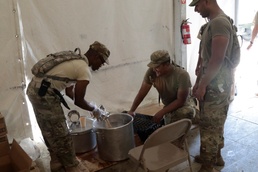
FORT POLK, La. – Imagine being in charge of feeding a lot of people … no, imagine a LOT more … every day for two meals a day. More than 3,300 people each meal, to be exact. Then imagine being told that you only have three hours to feed that many people. That comes out to feeding an individual every 3 to 7 seconds.
That’s right, every 3 to 7 seconds. And the mess section of the 76th Infantry Brigade Combat Team does just that during every meal they serve during training at the Joint Readiness Training Center here in central Louisiana.
The job is so big that four mess sections -- three from Indiana and one from Connecticut -- have been brought together to feed the hungry soldiers. It’s a first for Staff Sgt. Brandon Hess, an Army cook with more experience than most other cooks under him.
“In my 16 and a half years, the most I’ve ever cooked for was 2,000,” Hess said. “This is the biggest function that I’ve ever ran and ever cooked for.”
The first shift of the day starts at exactly midnight breaking down modules, or food packs, which feed 50 personnel each. During the course of a meal, the cooks will use more than 60 modules to feed the soldiers, having to break each module down to its components before cooking.
The cooking takes place in four CKs, or containerized kitchens, which are basically triple-wide trailers with kitchen equipment. While the CKs are considered air-conditioned, that equates to a fan which stops working with the heat of one burner. Each CK has six burners working at all times.
“Once all six burners are working, there’s nothing you can do but sweat,” Hess explains. “The thermometer maxes out at 184 degrees in there and we hit it.”
In order to keep morale up under those conditions, the mess sergeants do what they can to make it fun for their Soldiers. Staff Sgt. Justine Jones is with Company E of the 113th out of Indianapolis while Staff Sgt. Jeffrey Walker is with the 319th Support Company from South Bend, Indiana. As their teams began to work together, they decided to up the stakes.
“There’s a friendly competition between the crews,” Jones said. “We timed how long it took a soldier to get from the back of the line, fed, and sat down with each of our lines.”
“Approximately 5 minutes and 47 seconds for one crew and 5 minutes and 55 seconds for the other,” Walker added.
The dining facility seats only 300 personnel, so getting more than 3,000 through in 3 hours takes a concerted effort, but that doesn’t mean they skimp on the food. During a dinner meal earlier in the week, the menu included rotisserie chicken, cheesy broccoli, salad, fruit, bread, dessert, and a choice of drinks. The work of the mess section doesn’t go unnoticed by the 76th leadership, either.
“They’re cooking meals for more than 3,000 soldiers twice a day and getting them through that dining facility in 3 hours,” said 76th Command Sgt. Maj. Steven Bishop. “How they do it, I don’t have a clue, but it’s fun to watch them and to see how much morale they have because they’re getting a chance to do their job.”
Col. Robert D. Burke, commander of the 76th IBCT, agreed completely, adding that the cooks allow the brigade to sustain and take care of soldiers in the field.
“They play a key role in that so I’m very happy to see us bring back a job that is critically vital to our sustainment in the field,” said Burke.
For Walker, a former 11B aka infantryman, who is new to the job, what he discovered about the cooks was eye-opening.
“Coming off the line, you’re thinking you’re infantry, you’re 11 Bravo, you’re the fighting force,” Walker said. “But learning this part of the operation … it’s amazing. Just to find out how hard these guys work to nourish my boys out on the line, it’s unbelievable.”
For a job which many soldiers overlook, the soldiers of the 76th IBCT mess section remain upbeat and serve day-in and day-out making sure their fellow service members are well fed. They work in staggering heat doing a job that they love.
Hess said it best when asked about those personnel who pay them no attention …
“Come do our job for one day.”
-30-