By Michael Behlin
3rd Sustainment Command (Expeditionary)
CAMP TAJI, Iraq – Getting Iraq to the point of being able to sustain itself in all operations is an important factor in today's war on terrorism.
With the country being able to govern, defend, and sustain itself, the U.S. military presence has the possibility of being reduced.
Getting the military to the point of sustaining itself means getting it trained to handle the tasks and requirements expected of them. Whether it be combat operations, engineering, or transportation, having an Iraqi military knowledgeable in these areas would be beneficial.
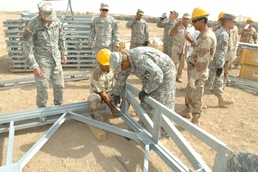
Aiding in the engineering side of things is the 74th Multi Role Bridging Company, 20th Engineer Brigade, of Fort Hood, Texas, whose members have been training Iraqi army engineers in the finer points of bridge building.
The 74th MRBC, which is based at Joint Base Balad, Iraq, is well on its way to training an efficient Iraq combat engineer unit capable of handling bridge operations on its own.
"Our goal here is to go through sort of a crawl process to get familiar with the bridges and be able to build one on their own," said 1st Lt. Benjamin Johnston, 74th MRBC 2nd Platoon leader and Dayton, Tenn., native. "The end goal is to have the Iraqi engineers able to stand up a bridge company on their own and our goal here is to start the initial training."
To complete this task, the 74th MRBC members, through a translator, taught the Iraqi engineers the basics on how to build different types of military bridges. The engineers went through days of classroom instruction and hands-on training which taught the basics of how to construct a temporary bridge. More instruction was planned during the trip, but with Ramadan beginning and as respect to the Iraqi engineers, training came to an end.
Even though the training ended early, the engineers saw this training opportunity as a sign of what's to come in the future.
"This training is important to the Iraqi engineers because they learn to operate in this capacity on their own," said Staff Sgt. Jorge Acevedo, 74th MRBC section sergeant and El Paso, Texas, native. "With the Iraqi engineers being knowledgeable about bridge building, they rely less on coalition forces."
Johnston agreed with Acevedo that the training and the end result is important to the Iraqi Army.
"Any military needs bridging assets and the capability to bridge," he said. "Also, as we start transition more control over to the Iraqis, there are a lot of temporary bridges in country that would need routine maintenance and having the military trained would be a bonus to the country being able to sustain."
The training, while short, was beneficial to both the country's future and infrastructure. Having safe transportation methods would allow civilians, troops, and supply convoys to travel throughout the country more effectively.
This training is all a part of what's to come for the country of Iraq as coalition forces continue to transfer control.
"Obviously, our long-term goal is not to be here forever, but this gives the Iraqis some ownership of their bridges and makes them more proactive in traffic control in making sure the bridges aren't damaged," said Johnston. "As we transition to giving them more control of their own country, it allows them to have the internal assets to do what they need to do, and where they need to do it. It's important for them to be able to make those decisions in the future as opposed to the U.S. military."