By Dustin Senger
Area Support Group - Qatar
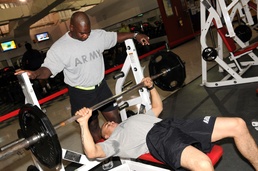
CAMP AS SAYLIYAH, Qatar – Active duty Soldiers travel to numerous military installations throughout their careers; few leave a lasting impact. U.S. Army 1st Sgt. Donald Williams, from Houston, Texas, is committed to leaving a legacy of strength training at Camp As Sayliyah, after completing his assignment as the Area Support Group Qatar headquarters-headquarters company first sergeant.
Williams first started powerlifting over 34 years ago. He no longer competes but continues to coach, sharing his passion and experiences in a way that echoes like a motivational speaker for physical performance. His successful and extensive training history is readily exhibited after encountering him; a barrel chest, thick back, and dry, cracked hands marked by numerous calluses – battle scars that never seem to clear. The look is typical for most men in his sport. Today, the Soldier spends most evenings hovering over the free-weight area at the Camp As Sayliyah gymnasium in Qatar, a Gulf country seated on the eastern coast of the Arabian Peninsula.
"Strength training helps prepare Soldiers for combat situations," said Williams, a veteran who served in places like Panama, Kuwait, Iraq, Afghanistan and Guantanamo Bay. "Carrying body armor and moving heavy equipment causes injuries in untrained people. I have seen a lot of Soldiers suffering from hernias due to insufficient strength. Aside from that, resistance training – even just a little bit – can help anyone become more athletic overall." ASG-QA executes the U.S. Central Command rest and recuperation pass program, recharging over 165,000 war fighters since its inception in 2004. ASG-QA provides participants an opportunity to relieve stress through organized sports and strength challenges.
"Before I retired from competitions in 2006, I became the post powerlifting champion everywhere the Army sent me," said Williams, completing 25 years of active duty service in January 2009. In 1998, while stationed at Fort Polk, La., he set a state record by bench pressing 350 pounds, while weighing only 170 pounds. "Powerlifters don't have to be big – they have to be tough, pound-per-pound," he said. After his state record, Williams started to advance in weight classes. He competed at 181 pounds until 2000, and then moved up to 198 before retiring. "I once lifted 500 pounds, but the most I ever did in competition is 450 – feet flat, back on the mat, down to my chest with a pause."
"I have a lot of strong people in my family," said Williams. He started weight training while growing up in Texas during the 1970s. The emerging athlete entered and won his first local competition at 10 years old, the age he started strength training.
"In high school, I competed in several bench press competitions each year – I always won," said Williams. "I was the first student to lift 400 pounds. Soon after, I started to train my little cousin and he eventually became the first to lift 500 in high school." Anthony Clark moved on to earn the national honor as the first teen to bench press 600 pounds in a sanctioned event. As an adult, he is the first man to reverse-grip press 700 pounds. At the Arnold Classic 1997, a crowd watched Clark become the first to push 800 pounds. According to Williams, many people contested the judge's approval of the sport's milestone lift, so Clark later pushed 815 pounds to hush the outcries.
"To help us host serious strength competitions at Camp As Sayliyah, we need more competitive equipment," said Williams. "We are still looking but some is ordered." Two new power benches are on their way, equipment that safely accommodates a natural range of motion. The current weight bars, after years of losing their luster, will all be replaced. Two lifting platforms will be available for dead lifts and general cross-training. "The purpose is to make the gym more attractive, productive and safe," he said.
"I plan to conduct strength clinics soon," said Williams. "The goal is to explain how to get strong while staying safe, based on my experiences. I did this in Afghanistan and it was a big success."
He doesn't believe in promoting high-volume training. "One of the worst things is staying in the gym too long. I believe trainees need minimal exercises but maximum intensity. You have to train with the right mindset, and then reward yourself by knowing when to add a little more weight. Nobody needs supplements; I have never used any. Workout journals, or mental logs, are needed to plan progression – to get strong, never train clueless."
"Our first major bench press competition is Sept. 18," he said. "We have had strength challenges before, but this will be a first for the serious lifters on camp."