By Spc. Opal Vaughn
14th Public Affairs Detachment
TIKRIT, Iraq – It is early still. The sun creeps up in the sky letting everyone know just how hot it really is, 98 degrees and still climbing; Just another average day in Iraq.
In the distance, waves of heat fumes rise from the hot asphalt roads that are now soiled in puddles of car oil and scattered metal. The smell of oil and smoke meanders in the dry, still air.
Firefighters working ferociously are slowly losing a battle between themselves and prying open a mangled truck's hood as Air Force Security Forces cordoned off the area around the two vehicles.
Suddenly the hood gives way to defeat as firefighters jam a crow bar into the heart of the truck engine killing the ear piercing sound of the whaling horn set off by a two vehicle head on collision at an intersection at Contingency Operating Base Speicher, located in Tikrit, Iraq, July 11.
"We rely on the public to relay a lot of the information we get because obviously we cannot be everywhere at one time," said Air Force Staff Sgt. Dale Gutierrez, a Security Forces crime investigator originally from Virginia Beach, Va., with the 732nd Expeditionary Security Forces Squadron, Detachment 1.
"Thankfully, this guy rolled up and said, 'hey there's been an accident right down the road,'" Gutierrez says rushing back to his vehicle, after stopping a civilian for excessive speeding.
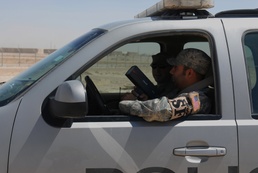
Immediately, Gutierrez and partner, Staff Sgt. Scott Harris, a SF patrolman originally from Carver, Mass., also with 732nd ESFS, Det. 1, spring into action. Switching on their lights and sirens, they are the first team to arrive at the scene of the accident.
Major accidents like this don't happen too often at Speicher, Gutierrez recalls, only having dealt with three others. But if they do, the Air Force Security Forces are always prepared, Gutierrez explains.
"We're all trained well. We automatically react because safety and professionalism have been engraved in us by the training we receive," Gutierrez stated.
"When you approach a scene you start assessing the situation immediately," Gutierrez explained. "Sometimes it is possible that victims can be excited, agitated and even irate, but it's something we have to deal with."
Two men, the drivers of the vehicles, stand on the roadside dazed but uninjured. Both vehicles set in the middle of the intersection crumbled against each other like crushed soda cans.
On scene, Gutierrez and Harris move into a rhythm by checking on the drivers and continuing to cordon off the accident site.
"In this case, we drove up to the scene of the accident and immediately we started looking at the placement of the vehicles, if there's any skid marks and if there are any casualties," Gutierrez added.
"Fortunately, there weren't any complications and after the scene was cleared, we immediately started the investigation process," Gutierrez said. "That includes measuring skid marks, doing field sketches and taking photographs."
Responding to traffic accidents is just one of the many responsibilities of the AFSF.
Earlier in the day, while everyone was still in their beds sleeping SF was out on patrol keeping the roads of COB Speicher even safer.
"The greatest part of our job is safety first and above all," said Air Force Senior Airman Jeff Klippel, a SF patrolman originally from Milwaukee, Wis., with the 732nd ESFS, Det. 1.
"We've been working on improving the safety levels at Speicher," explained Klippel while on patrol with partner Air Force Staff Sgt. John Kimbey, a SF system flight chief originally from Dayton, Ohio.
Klippel continued, "We have several flights that conduct routine patrols across Speicher at all times day-and-night to make sure that safety remains a priority. Adding more metal stop signs, painting speeds bumps on the roads and lighting along select areas across the COB are some things we are currently addressing."
Pulling into a vacant parking lot next to a high mobility multipurpose wheeled vehicle parked in the wrong lot, Kimbey and Klippel stepped out of their vehicle to process the vehicle.
"This job is not an easy job, nor is it always the most exciting to do. It takes a special kind of person to do this job with a high level of tolerance," said Kimbey while circling the empty vehicle.
"We understand that people have more important things to think about than me giving them a ticket because they were going a little bit too fast. I don't want to make their stay here worse than it needs to be," Kimbey added.
"Back in the home states we get a lot of D.U.I's, domestic violence and shop lifting. But here, there is a lot of traffic incidents and sexual assaults," Kimbey said.
"Everyone needs to understand that we're all here for the same mission," said Kimbey. "We don't go out of our way looking to catch people. We just enforce the standards and garrison policies that are set in place to keep everyone safe here at Speicher."
Just as Kimbey and Klippel begin to get back in their vehicle, the driver of the Humvee steps out and notices the two law officers preparing to leave a ticket.
"We try to be lenient but if someone tries to force our hand, there's not much we can do. You're just going to get a ticket," states Klippel after briefing the Soldier on safety and letting her go with a warning.
"Our primary mission is force protection, be it flight security, law enforcement, installation control or air base defense," Kimbey said. "The Soldiers protect and defend outside the wire and we serve inside the wire, protecting our home."
One thing remains true; safety will continue to be the number one priority of the AFSF.