By Sgt. 1st Class Christina Bhatti
2nd Stryker Brigade Combat Team, 25th Infantry Division
CAMP TAJI, Iraq – Getting the Iraqi police on their feet and operating as the main effort of law enforcement in the country has been a priority of the U.S. Army.
Since the force began to rebuild after the U.S. led invasion in 2003, they have been the center of controversy, often accused of rogue tactics, corruption and working for powerful political forces instead of the people. Citizens deeply distrusted those commissioned to protect them.
The daunting task of rebuilding a force and putting a trusting face on the policemen fell on the shoulders of American forces.
More than five years later, the face of Iraqi police is changing. They are better trained and screened. U.S. Soldiers are instrumental in their training, constantly pushing them to be the face of trust with the people.
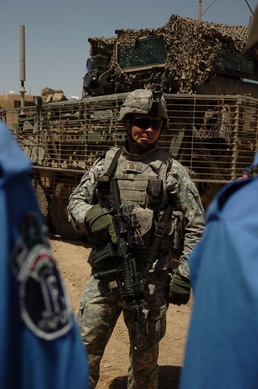
At the Shat al Taji IP station, northwest of Baghdad, the Soldiers of 2nd Squadron, 14th Cavalry Regiment, "Strykehorse," 2nd Stryker Brigade Combat Team, "Warrior," 25th Infantry Division, Multi-National Division – Baghdad take on the training task.
There are approximately 180 officers at the station, all graduates of the police academy, but Col. Ali Mahmood Azzou, Shat al Taji IP station commander, said the supplemental training done by U.S. forces gives his police more information and reinforces the teachings of the academy.
Azzou is a new commander at the station. He recently transferred from an IP station in Mosul, an area with what he describes as "violent and dangerous to the residents and police."
He said he hopes the quiet of Taji and the training by U.S. forces will help in the development of his policemen's basic skills and help them get better at dealing with the residents.
"I am inspired by the way U.S. forces treat each other and civilians," he said. "I've observed their humane, civilized and intelligent ways."
Every week a platoon, headed by Sgt 1st Class Pierre Berube, a native of Lewiston, Maine, visits the IP station to train groups of policemen. The platoon sergeant from 2nd Sqdn. 14th Cav. Regt. said he develops a training plan based on recommendations from Azzou and past training sessions. Each session consists of Berube and his platoon training groups of 10 officers. Those trained police officers area expected to pass on their knowledge to their comrades.
"Due to their mission requirements, we only get five to 10 Soldiers," Berube said. "It is supposed to be a train the trainer idea. Sometimes that happens and sometimes it doesn't"
But for Berube and his Soldiers, that is not the most challenging part of the training. Getting and keeping the policemen motivated present obstacles that have forced Berube to come up with techniques to get the men moving and wanting to learn.
"We expect them to do things how we do things, but they have different gear and mindset. "To help them find their motivation, Berube tries to instill confidence and different training methods to his sessions. The most common tactic he uses is competition. He said competition forces the policemen to want to get better because "everyone wants to be the best."
The symbiotic relationship between the IP forces and U.S. forces benefits from this training. U.S. Soldiers patrol the streets of Taji with the policemen showing the residents that the police are ready to care for the people.
"They work together and learn," said Azzou. "This is good and helps people trust the police."
That trust is what Berube said he wants to build on.
"When we go on patrol, they are not just seeing Americans coming in," Berube said, "They see them out there as well, and it helps us because they have a better understanding of what is going on. This helps all of us and will help them in the future.