By Spc. Jason Jordan
1st Brigade Combat Team, 10th Mountain Division
KIRKUK, Iraq – The night is quiet and the desert floor is still, but serenity can quickly turn into turmoil for the Convoy Security Element with the 1st Brigade, 10th Mountain Division's, 10th Brigade Support Battalion in northeastern Iraq.
Soldiers, of Task Force Warrior's 10th BSB, have been responsible for re-supplying remote Forward Operating Bases, and Patrol Bases in an area approximately the size of Rhode Island in Kirkuk, Iraq, since September.
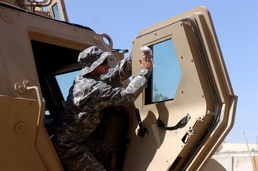
Unlike convoys back home, these convoys are more akin to a scene in a Hollywood science fiction movie, Soldiers, outfitted in full protective body armor, man weapons mounted atop large, intimidating vehicles that roll through the desert with the deep, rumbling roar of diesel engines circumventing traffic where a threat may exist along pock-marked, patched roads, the constant reminders of past improvised explosive device detonations.
These 10th BSB convoys consist of several military vehicles, along with 18-wheeled transportation trucks, and can often span as long as three miles. Each vehicle is equipped with state-of-the-art computer navigation systems.
"We are executing a classic 'hub and spoke' supply distribution system throughout AO Warrior," Lt. Col. Joseph Novack, commander, 10th BSB said. He describes the BSB supply points at FOB Warrior as the hub, "and the spokes that protrude from the hub represent the routes leading to the outlying bases," he said.
The mission of the 10th BSB, Company Alpha, is to keep these outlying bases stocked with essential supplies including food, water, fuel, mail, ammunition, medical supplies, repair parts, protective barriers and anything else that is needed or requested by the Soldiers who live and operate out of those remote areas.
The Soldiers face a daunting task, for their mission is fast-paced and never-ending; requiring detailed planning, coordination and execution. They are often long and perilous, with possible danger lurking everywhere.
"Our eyes are already searching the horizon before we even roll out of the gate," said Pvt. Mick Knehans, Co. A., CSE driver, who fills in as lead driver. "As the lead driver, I feel responsible for everyone following behind me." The full weight of that responsibility is understood by Knehans. "I make it my duty to remain extra vigilant so that I might spot that ambush or that IED that might be lying ahead."
A number of Soldiers are prepared for firefights should they need to protect the convoy from ambush attacks, while a team of combat medics are prepared to give aid to anyone requiring it.
"These Soldiers are quiet professionals as they go about conducting their mission everyday," Novack said. "Most people do not realize the amount of effort that is required to sustain a brigade combat team."
The battalion's nickname is Sherpa, which derives from the ethnic group of people found in the mountainous region of Nepal, high in the Himalayas. They are often employed as guides for mountaineering expeditions there, particularly to Mt. Everest.
In keeping with their namesake, these unsung heroes of the Sherpa battalion sum up their mission with their motto, 'Proud to Support'.
"The payoff to the unit from what these Soldiers do is phenomenal," Novack said.
The Sherpa commander said that essentially, the combat force, as a whole, could not be sustained without the effort put forth by the 10th BSB Soldiers.
"The hours are long and the constant effort required for this type of mission can be demanding, but at the end of the day – the feeling of gratification that results when you brightened another person's day is fully rewarding," said 2nd Lt. Ries Bryon, 10th BSB Co. A, platoon leader.
The Sherpas have conducted more than 300 combat logistics patrols, accumulating more than 300,000 miles – transporting more than 1.5 million gallons of fuel, and over 2 million gallons of water – along with many other tons of supplies throughout the brigade's area of operation, "without any single mission failing because of logistics during the entire deployment," Novack said.