By Robert Frenke
III Marine Expeditionary Force Public Affairs
CAMP FOSTER, OKINAWA, Japan – The Marine Corps Bases Japan exercise tested emergency response plans, policies and procedures for events such as terrorist attacks and mass casualty incidents.
Exercises such as Constant Vigilance have become a vital part of training for all personnel since 9/11, according to Jay Farmer, the deputy assistant chief of staff for training and operations for MCB Camp Butler.
"Unfortunately, there are folks out there who mean us harm," he said. "A soft target is an easy target, so it's important that we harden our security and our personnel to try and prevent something like this from happening."
A complex scenario at U.S. Naval Hospital Okinawa on Camp Lester kicked off the exercise May 6. Two terrorists attempted to drive a vehicle-borne improvised explosive device into the front of the hospital, but the device failed to detonate. The terrorists fled into a nearby housing area and took hostages.
While military police forces reacted to the hostage situation, the hospital staff was tested with a massive influx of simulated casualties that resulted from the explosion of a KC-130 on Marine Corps Air Station Futenma.
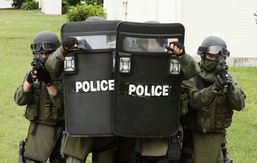
The hostage scenario lasted through Wednesday evening when the provost marshal's office sent in its Special Reaction Team after negotiations failed.
The initial terrorist incident prompted officials to raise the threat condition level on all installations to condition Delta, which elevated security measures across all installations and prompted the activation of MCB Butler's auxiliary security force. Armed sentries with the ASF beefed up security at gates and checkpoints and searched incoming vehicles.
The exercise's most realistic scenario, according to Farmer, involved a terrorist-detonated explosion at Camp Foster's old Gunner's Gym the evening of May 6. The MCBJ Fire Department and emergency medical technicians had to work quickly to remove simulated victims from overturned vehicles while simultaneously putting out fires before they could enter the building to save any survivors.
"The amount of realism we tried to put into this exercise can only help make us more prepared," Farmer said. Brian Johnson, chief of the MCBJ Fire Department, said the exercise and its scenarios helped promote interoperability between Marine Corps Base emergency response units. "The scenarios are typical of real life," Johnson said. "This is the kind of training we need to be doing constantly to keep prepared for anything."
Farmer said the large number of people and organizations involved in the exercise helped add to the realism.
"We're all a part of the equation when it comes time to protect ourselves from any terrorist event," Farmer said. "We must be ready for any kind of attack. A mass casualty incident can take place anytime, anywhere. We need to be well prepared."
Farmer said that Constant Vigilance 2008 was the largest and most realistic anti-terrorism force protection event here since 2001.
"I think the staff here has a good mindset as far as dealing with anti-terrorism events," he said. "The event has run fairly smoothly. I think we'll be well prepared for any events like this."
Lance Cpl. Daniel Gonzales, a simulated victim during the scenario at the gym, said the exercise gave him confidence in the command's abilities to respond to these types of events.
"If something like this really does happen, this type of training really prepares us to handle it," he said. "It's good that we do this. Marines go to Mojave Viper and (the Jungle Warfare Training Center) to train for war; we should also be training for this kind of stuff just in case."