CAMP BUTNER, N.C. – 3rd Military Information Support Battalion arrived here Friday to practice civil authority information support operations to ensure they are ready to assist federal, state and local authorities in the event of a disaster.
Maj. Brian Horvath, operations officer for 3rd MISB, designed the event to test the unit’s ability to assess information, create print, video and radio broadcast materials, and distribute those materials to a civilian population affected by a disaster.
Other agencies involved in the training include a tactical psychological operations detachment from 9th Military Information Support Battalion, two Marine military information support operations teams, and personnel from the Federal Emergency Management Agency.
Participants came to Camp Butner to provide CAIS support following a notional earthquake that ravaged the local area. With FEMA as the lead federal agency, 3rd MISB utilized their organic dissemination capabilities while incorporating the varied capabilities of attachments to train on potential life-saving actions as a task force.
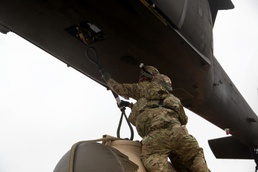
As part of their training, they published messages from the governor via loudspeaker, developed and distributed handouts from the Red Cross, and they provided food and water deliveries to hard hit areas by sling-load.
Pfc. Keisha Brown, a combat camera photographer with Company C, 3rd MISB conducted aerial photography to capture roadway, bridge, building, and infrastructure imagery in support of a domestic imagery request from the office of the notional governor. The imagery collected provided a means for damage assessment efforts to determine the extent of local rubbling by the intraplate earthquake that rocked Raleigh in this scenario.
“I’ve never been on a helicopter before, this was the best thing ever,” Brown said following her surveillance mission on the Black Hawk, “I didn’t snap as much as I could have but I documented the devastated areas.”
While the training relied heavily on role players and simulated or notional events and damage the training value is tangible. Units produce the print, radio, and video products themselves making use of their unique multimedia production capabilities.
Marine Staff Sgt. Ronald Caudle, a military information support operator with the Marine Corps Information Operations Center in Quantico, Virginia provided operators to engage with role-players to simulate interactions with news media during crisis response.
“For my Marines that interviewed, this training was essential. This is exactly what they’ll be expected to do real-world when they deploy soon,” Caudle said following the training, “the opportunity to integrate with the Army and other agencies, and this humanitarian assistance disaster relief type mission, is exactly what they will face down range.”