By Spc. David Hodge
1st Brigade Combat Team, 4th Infantry Division
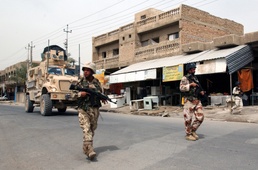
BAGHDAD – Multi-National Division – Baghdad Soldiers are patrolling the streets of the Rashid District in the Department of Defense's latest defensive measure to defeat the improvised explosive device, the number one threat against Soldiers in Iraq.
Soldiers from the 1st Brigade Combat Team, 4th Infantry Division, stationed at Forward Operating Base Falcon, are trading their up-armored gun trucks for the mine resistant and ambush protected vehicles, recently issued to U.S. Armed Forces in support of Operation Iraqi Freedom.
Pfc. Shaun Landers, personnel security detachment, Headquarters and Headquarters Detachment, 1st BCT, 4th Inf. Div., said he prefers the MRAP over the Humvee.
"The MRAP was built around the Soldiers," stated Landers, a cavalry scout from Anchorage, Alaska. "I feel very safe and confident operating this vehicle. It gives us that tight turning radius we desperately need."
In October, 2007, the 4th Brigade Combat Team, 1st Infantry Division, became the first unit in Iraq to receive the MRAP vehicles, said Sgt. Marquis Dawkins, a mortarman assigned to the PSD, Headquarters and Headquarters Company, 4th BCT.
"I'm impressed with the MRAP," said Dawkins. "The first time I saw it, it was intimidating. It was striking."
During the last six months, Dawkins said the MRAP has proven itself effective in the war on terrorism.
"If a bad guy sees the MRAP coming down the road, he would probably turn and go in the opposite direction," said Dawkins, who hails from Brooklyn, N.Y.
The better the protection, the better Soldiers can pay attention to the mission at hand, said Spc. Christian Schmidt, an infantryman assigned to the PSD, HHD, 1st BCT.
"The MRAP makes it easier for us to focus on the mission outside the wire," said Schmidt, who hails from Ponce, Puerto Rico.
Sgt. Michael Banaszak, infantryman assigned to the PSD, HHD, 1st BCT, 4th Inf. Div., is the truck commander for the 1st "Raider" BCT's brigade command sergeant major, Command Sgt. Maj. Michael I. Bobb.
According to the international mine protected vehicle student guide the v-shaped hull of the MRAP is designed to deflect the force from explosions that originate underneath the vehicle, which increases the survivability for Soldiers.
"The Army has adapted to the ever-changing war climate here in Iraq," stated Banaszak, a native of Roseville, Calif.
The height of the MRAP is substantially higher so Soldiers must be safety conscious when operating the vehicle on the battlefield.
"The drivers and gunners have to consistently communicate," Banaszak explained.
The gunner is the only Soldier in the vehicle with a 360-degree view, he added. The driver and gunner must effectively communicate to successfully navigate low-hanging obstacles on the road.
"Overall in a combat zone, the MRAP should stand the test of time," explained Banaszak.
Banaszak said that the fielding of the MRAP vehicle shows the U.S. Army's commitment to protecting its Soldiers and the 1.2 million residents of the Rashid District.
"As long as the vehicles are safer and prevent Soldiers from sustaining injuries, I'd have to say it's a definite improvement," Banaszak said.
The Raider Brigade will take responsibility of the MRAPs while simultaneously assuming command from the 4th BCT, 1st Inf. Div., in April.