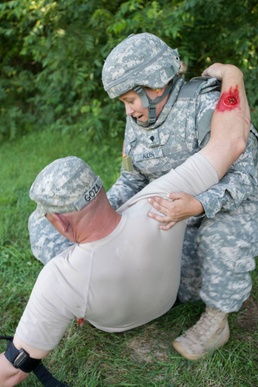
Explosions and gunfire echo off of buildings as Soldiers from the 35th Infantry Division hurriedly assess the casualties on the ground.
“This wasn’t at all what I expected,” said Staff Sgt. Josef Nichols. “I was assuming long days of PowerPoint presentations and a few classroom exercises – not a full-on combat scenario with pyrotechnics.”
Nichols, along with approximately 12 other Soldiers attended the Army's Combat Lifesaver course at the 35th Infantry Division headquarters in Leavenworth, Kansas. Although typically taught as a week-long, 40-hour class, Sgt. Lauren Swensson, the division’s medical readiness noncommissioned officer, reconfigured the course schedule to allow Soldiers of the 35th Infantry Division to complete the training over just two individual drill training weekends.
“I originally wanted to conduct the training during our annual training period next summer,” explained Swensson.
“But the schedule was already packed for those few weeks.
So instead, I pooled together requests and memorandums, drafted up a training plan, got the training aides, put together packets for the Soldiers and divided the training into two phases.”
The first phase consisted of three days of classroom work and written exams. During the second phase however, the student's knowledge was put to the test in a mock field training simulation. Often, hands-on training for a CLS class consists of only using dummies in a classroom environment, but this time was different. Thanks to the diligent coordination of resources on Swensson's part, the students went outside for more realistic training. Using a simulated improvised explosive device to create mock explosion sounds as well as a .50 caliber rifle simulator, students were forced to perform what they learned under extreme external pressure.
"I took CLS at Basic Combat Training in 2014, but I learned much more here,” said Spc. Alexandra Allen, a human resource specialist with the 35th ID. “This class was much harder and I think we all got a lot more out of it."
“The explosions, gunfire and screaming casualty actors made it difficult to concentrate at times,” said Nichols, “but it forced you to communicate with your team members a lot more, which is imperative in these types of situations.”
The students were required to practice many of their newly-learned skills including calling in a nine-line medevac request, applying tourniquets and pressure dressings, treating mental trauma, and moving wounded Soldiers to a safe area.
"When I was in the Marine Corps, we were conducting a pre deployment field operation on Mount Fuji when two seven-ton trucks collided,” recalled Swensson. “One Marine was killed instantly and four others were severely injured. Thanks to our training and quick reactions we got them off the mountain by life-flight.”
That was Swensson’s first military experience in understanding the importance of being ready for life-saving skills under pressure. She later received Emergency Medical Technician certification and continued to volunteer at hospitals while deployed.
When the time came for her to get out of the Marine Corps, she knew the importance of the medical field and wanted to continue along that path. While attending classes at the University of Kansas, a doctor talked to her about the National Guard and joining the Physician's Assistant program.
"I joined the Guard in 2011 and went to 68 Sierra school (preventive medicine specialist) since I had never been an actual medic in the military," Swensson said.
"I think CLS training is very necessary from an active duty standpoint and even more in the National Guard,” said Swensson. “At the end of the day we are going to get in our cars and drive home. Things happen, and if you are in a crowd as someone that can help, you really might save a person's life."