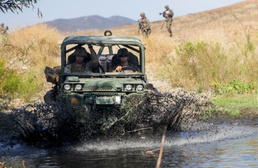
FORT HUNTER-LIGGETT, Calif. - The Marine Corps Warfighting Lab (MCWL), in cooperation with Company B, 1st Battalion, 1st Marine Regiment, 1st Marine Division, conducted a three-week live force-on-force experiment aboard Fort Hunter Liggett, CA, from Aug. 24- Sep. 14.
The experiment was designed to provide a Company Landing Team (CLT) with Internally Transportable Vehicles (ITVs) in order to determine the characteristics, quantities, and potential variants required in the next generation ITV slated for future fielding to Marine Corps infantry battalions.
The experiment consisted of numerous tactical lanes of varying lengths, vehicle quantities and configurations, and employed against complex tactical scenarios. Numerous experiment observers and controllers were deployed at every stage of the event to capture the metrics and other data required to evaluate holistically the infantry community’s requirements for the future vehicle.
Major Robert Storck, the officer in charge of Expeditionary Force-21, Limited Objective Experiment-1 (EF-21 LOE-1) said, “Marines from Bravo Company and the venue greatly aided in informing the critical requirements and developing concepts of employment for the ITV replacement (ITV-R). The Marines discovered more effective ways to employ the vehicles and used them to improve their infantry tactics and proficiency in subsequent lanes.”
“At Fort Hunter Liggett we have plenty of space to run our experiment lanes and to employ the ITVs in a realistic manner,” Storck said. “This has really allowed us to see some of the major advantages and disadvantages of the current ITV so we can make more appropriate recommendations for the vehicle of the future.”
Captain Sean Leahy, the commanding officer of Company B, 1st Battalion, 1st Marine Regiment, says the vehicles, while ineffective as a strike vehicle, worked well as a logistics vehicle allowing his Marines to take a large portion of the weight off of their backs.
“The biggest benefit an ITV style vehicle is going to bring to the infantry community is not in a fighting role or a strike role,” Leahy said. “A vehicle like this should be used as a logistics asset that can lighten the load of the individual Marines which in turn makes them more alert and in the long run more combat effective.”
Even though the experiment was developed to obtain recommendations for the ITV-R, Bravo Company also used it as an opportunity to hone their infantry skills.
“Any time we get to go out to the field for three weeks, doing our job is excellent,” Leahy said. “It makes us stronger, faster and much more proficient in preparation for Bridgeport and eventually for any future deployments.”
During EF-21 LOE-1, MCWL provided Bravo Company with twenty-two total ITVs configured as logistics, medical, command and control, and strike variants. The experiment concluded with a two-day final exercise during which Captain Leahy had the opportunity to choose the number of vehicles and variants needed to execute his mission.