Sgt. 1st Class Thomas Mills
3rd Combat Aviation Brigade, 3rd Infantry Division
CAMP STRIKER, Iraq – It's easy to assume the armament section in an aviation maintenance unit deals strictly with fixing weapons on attack helicopters. The truth is a bit more complicated, as armament Soldiers work on all aspects of the weapons systems on Apache helicopters, including electronics.
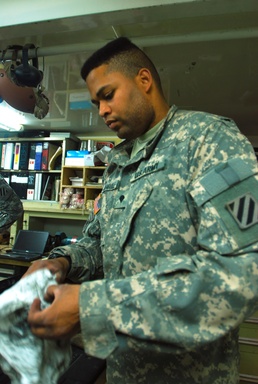
"This is probably the smallest part of our job, tearing down the weapons," said Spc. Seth Chambers, Company B, 603rd Aviation Support Battalion, 3rd Combat Aviation Brigade, 3rd Infantry Division, as he conducted a semiannual inspection on a 30 mm cannon. "The majority of it would be electrical; radios and trouble shooting systems like the sighting system."
"A lot of people confuse our job. When they hear armament, they think of us working on the guns," said Sgt. Reuben Parks, armament section maintenance supervisor with Company B.
Parks said on older models of Apaches, different specialists handled different systems on the helicopter. Electricians and avionics repairers maintained electronic systems and radios, while armament technicians dealt with the mechanics of the actual guns, rocket pods and missile pods.
When the AH-64D replaced the AH-64A model, the helicopter became more wired and weapons systems became more integrated with electronic sights.
"Ninety-nine percent of the aircraft is electronics now," said Parks.
The Army combined separate specialties into one military occupational specialty called the AH-64D Apache Longbow electrical, avionics and armament technician. Armament technicians were sent to a 92 day transition course at Fort Eustes, Va.
"It's at least two or three (military occupational specialties) combined," said Spc. Jason Jueanville, Company B.
"All the upgrades from the A model to the D model, we had to learn," Parks said.
"When you first come out of (advanced individual training) it can be a lot. If you don't have the ability to figure out how it all works together you can spend several months going after ghosts and not finding solutions to the problem," said Jueanville, from Trinidad and Tobago.
The armament section of Company B works on periodic phase maintenance inspections of Apaches and unscheduled maintenance as needed. They also assist Company D, 1st Battalion, 3rd Aviation Regiment armament technicians.
"We directly impact them," said Chief Warrant Officer 3 Francisco Vargas, armament section officer in charge. "The number of personnel they have is not enough to handle this mission with the current operational tempo."
The armament section has technicians at two forward arming and refueling points to fix any issues Apaches may have during a mission. They help out with unscheduled maintenance at the 3rd CAB flight line and also work with pilots to coach them through troubleshooting.
Armament technicians often have to switch from electrical to mechanical skills as they troubleshoot. One will sit in the cockpit working on the sighting system while another will check the actual guns or pods to ensure they are working correctly.
"The system does have limitations and you have to realize how to use it correctly," Jueanville said.
The maintenance processes make the constant change from electrician to avionics repairer to mechanic simple, Jueanville said.
"It's pretty easy because it's structured in such a way to transition you from the mechanical aspect to the electronic aspect."
For his part, Chambers, from Arvetta, Colo., said he likes to simplify things for people as much as possible. "If it has a wire going to it or if it goes boom, we work on it."