By Richard Blumenstein
3rd Marine Expeditionary Force Public Affairs
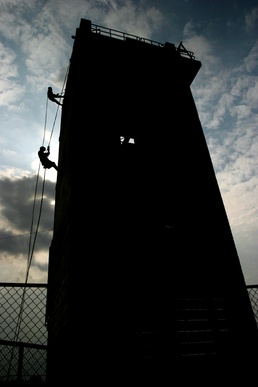
CAMP HANSEN OKINAWA, Japan — Jumping off Camp Hansen's 60-foot rappel tower and stopping half way down to tie off, then intentionally flipping upside down, and performing sit-ups may seem a bit crazy, but it served as a confidence-builder for 16 Marines taking part in the Helicopter Rope Suspension Techniques Master Course Feb. 29.
The Marines from various commands on Okinawa and Camp Fuji took part in the 11-day HRST Master Course to help supplement the Marine Corps' need for HRST masters, according to Sgt. Kevin D. Parish, a primary HRST master instructor with Special Operations Training Group, III Marine Expeditionary Force.
Units need HRST masters present to conduct operations and training events such as rappelling and fast-roping, according to Parish.
"Because the Marine Corps is amphibious, HRST masters serve as a crucial element in a number of operations such as Vessel Board Search and Seizure operations or operations where helicopters may not be able to land, (such as in) urban or jungle terrain," Parish said. "Basically anytime Marines need to rappel down a tower or out of a helicopter, a HRST master needs to be there."
For areas on Okinawa like the Jungle Warfare Training Center, a lack of HRST masters would cause serious set backs in the training schedule, according to Cpl. Cache E. Webb, an instructor with JWTC.
"For most courses at JWTC, you need a HRST master," Webb said. "Without them, most of the courses wouldn't be possible. It would greatly limit what we can do."
To test their skills and apply knowledge taught earlier in the week, the Marines conducted self-belay and tying-off exercises, according to Parish.
The Marines practiced self-belay techniques using a cordelette, a rope and knot system that acts as a secondary brake, Parish said.
The first Marine to rappel into the area uses a cordelette if there are no Marines on the ground to act as a belay man. The belay man acts as a break if the Marine loses his grip of the rope, according to Parish.
The Marines also practiced tying-off after jumping off the portion of the tower that simulates the side of a helicopter.
"If a helicopter does a premature lift or if the area becomes unsafe for them to insert into, (Marines) need to know how to tie off and lock themselves in to prevent harmful situations," Parish said.
Once stopped in mid-air, the Marines flipped upside down and began performing sit-ups as a way to gain confidence in their abilities, according to Sgt. Russell A. Douthat, a HRST master instructor with SOTG.
"It really goes into the whole aspect that as HRST masters, they're comfortable and confident in their abilities," Douthat said. "If a master goes to get someone on the ropes and flips upside down, he won't flip out."