By Sgt. Brandon Little
Task Force XII Public Affairs Office, Multi-National Division-Baghdad
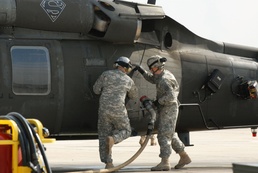
CAMP TAJI, Iraq – As soon as the vehicle pulls in, and is safe to approach, a crew rushes out to do their job. They work together in a swift yet synchronized motion pumping gallons of fuel into the gas tank, air into the tires and refilling other crucial items.
They're not a professional racing pit crew; they are Multi-National Division – Baghdad's Task Force XII Soldiers working at the Forward Arming and Refueling Point here.
Every day these FARP Soldiers transfer hundreds of gallons of fuel and thousands of pounds of ammunition into aircraft to keep them in the fight and the enemy on his heels.
An aircraft can land on the FARP, be refueled and reloaded with ammunition, and get back in the air to continue with its mission all in the time it takes to microwave a bag of popcorn or listen to a song on the radio.
"We're kind of like a NASCAR pit crew," said Sgt. 1st Class Freddie Epting, the platoon sergeant for the Distribution Platoon in Renegade Troop, 4th Squadron, 3rd Armored Cavalry Regiment. "We average about 3.5 minutes per aircraft; that includes loading ammo and giving fuel."
Since assuming control of the FARP in December, Renegade Troop Soldiers have refueled more than 2,500 aircraft and pumped more than 500,000 gallons of fuel.
This is especially unique because this FARP pumps hundreds of gallons of fuel into Air Force, Marine and other coalition forces aircraft, said Epting, a native of Gulfport, Miss.
"We pride ourselves on making sure the aircraft (move through quickly) because the more time they spend on my pad (equals) less time for them to fly around and make sure the area's safe," he said. "Speed is important, but we always make sure safety's first."
In addition to dealing with highly flammable liquids and explosive munitions, the Soldiers also have to constantly be aware of the spinning rotor blades on the aircraft they are refueling.
"There are cold refuels, but most of the time (flight crews) are like 'we have to go, and we have to go right now, and we need fuel,'" said Spc. Myisha Treadwell, an Atlanta native, who serves as a petroleum supply specialist in Renegade Troop. "So, (we provide aircraft) the opportunity to land, keep everything on, get fuel and get back out to their mission."
Treadwell is part of the three-person bag team responsible for pumping fuel out to the FARP line. After the fuel reaches the FARP line and the aircraft has been connected to a grounding cable, Soldiers attach a special nozzle to the helicopter and begin fueling.
"We have to use a D1 nozzle for hot refuels for most aircraft in the military," said Spc. Kyle Porteous, also a petroleum supply specialist in Renegade Troop and a native of Lawrenceburg, Ky. "The D1 is designed to prevent any vapors from escaping; this reduces the chances of a fire breaking out."
Having a fire break out could be disastrous, especially while Soldiers are loading the aircraft with rockets and flares.
"These rockets have a (large amount) of explosives inside them, and if everyone's not extremely careful, someone could get seriously injured or killed," said Pvt. Tommy Walker, a Converse, La., native, and an AH-64D Apache Longbow armament and systems repairer in Aviation Intermediate Maintenance Troop, 4th Squadron, 3d Armored Cavalry Regiment.
Having the Soldiers take their time to be safe and do things right is more important than them racing through steps to get done faster, said Epting.
The Soldiers might not move vehicles out quite as fast as a racing pit crew, but they have developed a system to get aircraft back into the fight safely.
"We have a great system set up to quickly get aircraft refueled, rearmed and back in the sky so when ground units are under attack, or going to on a very high risk convoy, they've got air power supporting them," said Porteous. "I know that by us being here, doing what we're doing, we're helping to save lives – and that's what matters."