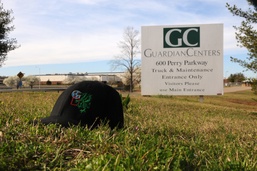
PERRY, Ga. - Members of the Air National Guard from all 10 Federal Emergency Management Agency regions arrived at the Guardian Centers, Perry, Georgia, on March 8, 2015, to participate in Global Dragon deployment for training. Guardsmen will train on chemical, biological, radiological and nuclear hazardous materials through March 21. To help lead the Airmen through training, Global Dragon cadres wear black hats and white badges with the Global Dragon logo on the front.
“Our simplified logo on the hat and badges is the letter G with a globe inside and the letter D with a dragon holding the globe,” said Tech. Sgt. Lyndsey Barclay III, Global Dragon DFT cadre assigned to the 147th Reconnaissance Wing. “The letters stand for Global Dragon.”
Global Dragon participants will handle live CBRN agents, which is a real-world safety issue. To help combat safety concerns, cadres for the DFT designed special hats and badges to be easily identified in the heat of the moment and help prevent a critical situation.
“The Air Mobility Command and Air Combat Command Inspector General set the standard for safety and identification,” said Chief Master Sgt. Doug Lang, Global Dragon DFT exercise director assigned to the 125th Fighter Wing. “We follow that standard set and carried it over with our own design for this exercise.”
Barclay personally designed the Global Dragon logo and explained the importance of what the globe and dragon represent.
“Dragons were considered the first all-around emergency, which goes back to the original mythological threat,” Barclay stated. “They were a biological threat because they were giant beasts and a chemical threat because they breathe fire. All of their threats together represented emergency management chemical warfare.”
The globe signifies the world and that emergency management Airmen are ready to respond across the globe at a moment’s notice. The dragon harkens back to the Army Chemical Corps coat of arms and emergency management heritage.
“The dragon is a chlorine breathing dragon,” Barclay explained. “In World War I, chlorine was the first chemical weapon used in battle. On the logo, the dragon appears to go after the world, trying to attack it. Emergency managers are here to protect the world.”
The first coin developed by the emergency management career field included the French saying ‘laissez les bon temps roulez,’meaning ‘let the good times roll.’
“It’s a play on words to lighten the mood considering all the challenges we might encounter and the various threats and hazards we would respond to,” Barclay concluded. “As emergency managers, we go into these situations with the laissez-faire attitude of, ‘this is what we are prepared to do.’”