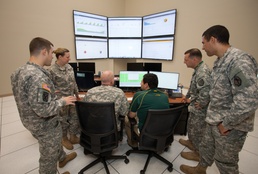
GEORGIA TECHNOLOGY RESEARCH INSTITUTE, Atlanta - On the last day of their specialized, cyber-security training, the GTRI and the Ga. National Guard set aside time for distinguished visitors to become more familiar with their essential mission and its impact on future operations.
After speaking with the Ga. Army National Guard Information Management Branch Chief, Lt. Col. David Allen, it quickly becomes crystal clear why this little-known mission capability of cyber defense is so very critical to the future of Ga. Guard's structure.
When asked why training like this is relevant, Allen quickly summarized, "(A cyber security breach or attack) is an (on-going) active threat. They're just like a natural disaster. (In the midst of recovering from one, is not the time to figure out you're ill-equipped.)" Allen also explained, "This is yet another capability that we, the Ga. National Guard, possess."
In speaking with the soldiers who posses these specialized skill sets, the need for this capability sells itself. Simply trying to understand the jargon they speak fluently and use to describe their work, is enough to tangibly prove that what they do cannot be learned overnight. The community needs them, their knowledge and moreover, we need more of them than the Ga. Guard currently has on the books.
Later this year the Ga. Guard will transition into a second iteration of a larger training event that encompasses multiple DoD agencies and military components.
The few trainers the Ga. Guard does have in its ranks are constantly being trained themselves. And there's no confusion as to why, either. Approximately every 18 months the technology playing field changes so much, that skills left uncultivated become outdated. That's where personnel numbers and partnerships like the one between GTRI and the Ga. Guard stand in the gap.
Recently, a new military occupational skill (MOS) was approved, and the Ga. Guard is hot on its heals. Sergeant First Class Tammy Rooks is the Ga. Guard's first candidate for the new "Cyber Defender" MOS. It is not an entry-level MOS, which means soldiers must apply for acceptance into the training that awards them these credentials.
Chief Warrant Officer 3 Samuel Blaney, an information protection technician with the Ga. Army National Guard, shed more light the world of cyber defense. He said two things were at the top of the list for why events like the May 2nd training are so important. "This event identifies training gaps for our soldiers, and it solidifies our partnership with GTRI. Without this partnership, we probably wouldn't' be able to do this."
With respect to the future of training and operations on a larger scale, Blaney further described the Ga. Guard's intentions framed with where it came from. "Two years ago, we had one cyber defense professional. Today, we have 25 that are ready and available to fulfill these roles. Their skill sets," he explained, "range from intermediate to expert. And we are looking at having another 20 beginner to intermediate professionals within the next 12 to 24 months."
With the Ga. Guard's growing ranks of cyber defense professionals and an ever-growing understanding of "the new battlefield," it's no wonder they are also vying to be appointed as one of the 10 national cyber protection (CPT) teams. These 10 teams correlate to the Federal Emergency Management Agency's 10 regions across the U.S.
"It would be ideal," said Blaney, "if FEMA region four's team were all from one state, for command and control purposes. (If selected) the Ga. Guard would, of course, be capable of and prepared to respond both locally and regionally."
With Atlanta being a booming technology hub, it certainly seems to make sense that the Ga. Guard would seek to boost its state's cyber workforce with traditional and full-time Guardsmen. If the Ga. Guard is successful in its vie to become FEMA region four's national CPT, it will continue to expand its partnerships with centers of excellence, like the Georgia Research Technology Institute.
More information about legislation supporting initiatives that impact and/or support this type of training, such as Senate bill S. 658 can be found at www.ngaus.org