By Sgt. 1st Class Felix A. Figueroa
82d Sustainment Brigade
Public Affairs Office
Logistics Support Area ADDER, Iraq — Nearly a year ago, 28-year-old Army Sgt. Virgil Swisher, 82d Sustainment Brigade, knew he would be deploying to Iraq. What he did not know was that he would be working outside the scope of his military occupational specialty.
"I came out here to do my job as a wheeled mechanic. I heard so many different things about Iraq and I expected to see what we in America see on T.V., but I was surprised," Said Swisher.
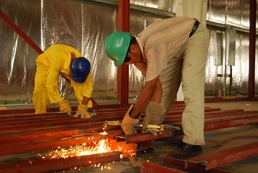
Since arriving at Logistics Support Area Adder in southern Iraq, Swisher along with other Soldiers throughout the installation were tasked out to provide security for the local nationals working on reconstruction projects within the base camp.
"They are not all that different from us, and they're not bad people. All these guys want to do is work and provide for their families," Swisher said.
The 82d Sustainment Brigade alone has spent close to 15-million dollars in reconstruction projects that range from the hiring of local contractors, to enhancing security measures for locals to work.
"I feel that by providing jobs for the Iraqis, we're not only providing financial stability, we are providing a positive outlook on life," said Master Sgt. Jermaine Davison, Senior enlisted contracting representative, 82nd Sustainment Brigade.
"Each time a local is hired, he learns what he can and can't do. We hire based off of actual skill set which encourages young men to get educated," Davison added.
During the Saddam regime, going to school or becoming a professional of sorts was highly frowned upon according to contractor Ayad Hasan Jobain, Asia Company. Instead, young men were encouraged and even paid more money to serve in the military, instead of becoming a college professor.
"I would say that 95 percent of the populace enjoys having a steady job instead of being paid to be a bad guy," said Jobain.
The 45 year old An Nasiriya native says without the opportunity provided by coalition forces, most men are likely to become recruited by terrorist cells.
"What I walked away with from this experience is respect for culture and respect for hard work, regardless of who's doing it," Swisher said.