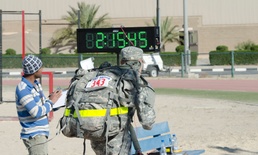
CAMP ARIFJAN, Kuwait – April 9, 1942: The Bataan Peninsula in the Philippines falls to Japanese forces. Prior to the United States' entry into World War II, soldiers from the 200th and 515th Coast Artillery Regiments deployed to the region.
American and Filipino forces fought against Japanese forces who received key reinforcements in April of 1942, which ultimately led to the surrender of more than 75,000 U.S. and Filipino soldiers.
As prisoners of war, they were forced to march more than 60 miles without food or water. Thousands died, many were killed for attempting to drink water from nearby streams.
Now, service members at Camp Arifjan are honoring those World War II heroes who made the ultimate sacrifice for their country. Hundreds of participants filed into the fitness center with rucksacks on their backs at Camp Arifjan, Kuwait, March 23.
Two scales waited in the middle of the gym to weigh each rucksack, ensuring the required minimum weight of 35 pounds was met for the Bataan Memorial Death March.
“The packs you’re carrying on your backs today are representative of those battle buddies they had to pick up and carry, or try to carry, to make it to the end,” said Master Sgt. Wilfrid Chapdelaine, operations noncommissioned officer in charge, 160th Signal Brigade.
Among the U.S. forces taken as prisoners of war during the Bataan Death March were deployed aoldiers from New Mexico, where the annual memorial march takes place. They offer two routes: a 26.2-mile course and a 14-mile short course to allow more participants the opportunity to honor the fallen.
Camp Arifjan’s course is slightly modified at 12.5 miles, which weaves throughout the base and around the perimeter.
“As you’re out there today remember: this is about teamwork,” said Chapdelaine to the crowd of participants. “Don’t let your battle buddies down. Don’t let your battle buddies fall. If they fall back, grab a hold of them. Start as a team, finish as a team.”
After final adjustments to their rucksacks, trading weight when necessary, and the morning prayer, the participants began the trek.
The 160th Signal Brigade’s colors were waving in the breeze as Chapdelaine led his soldiers on the march.
“My soldiers in my shop are my motivation,” said Chapdelaine. “I had a soldier who came to me almost a year ago now. He had some weight challenges and physical fitness challenges. He pulled himself up by his bootstraps and with a little bit of teamwork from the shop, he has overcome both of those challenges.”
Capt. Steve Pingree, commander, 511th Engineer Dive Detachment, said the Bataan Memorial Death March was a unit morale builder and a great way to honor the sacrifices of those World War II heroes.
“It was an opportunity to come out and do something hard,” said Pingree, who finished first at 2 hours, 15 minutes, 45 seconds. “I relied on the Lord for his strength and he pulled me through.”
This year marks the 25th anniversary of the Bataan Memorial Death March, which has spread throughout the U.S. and several foreign countries.
With the sun rising along with the temperature in Kuwait, this year’s participants marched on, some breaking into a run to finish the march strong.
“We pride ourselves on hard work, discipline, and teamwork,” said Chapdelaine. “We’re going to start as a team and finish as a team.”