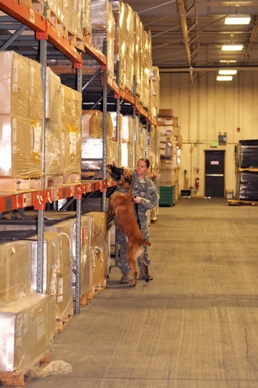
HEADQUARTERS, U.S. ARMY ALASKA, FORT WAINWRIGHT, Alaska - Effective communication, training and hard work is required for a bond to form between a canine and its handler. Additionally, extra time and effort is needed to help prepare the dogs for real-world scenarios through various exercises.
As handler and dog become a team, they constantly train to improve and advance their skill level. They start with the basics in detection and patrol work, then add in more complex tasks and harder training scenarios.
Staff Sgt. Ben Wilburn, a senior dog handler with the 549th Military Working Dog Detachment, detailed some of the main tasks performed by the dog teams and how they can be utilized on post and during a deployment.
“The dogs can be used in a lot of different ways,” said Wilburn. “Military working dogs are trained to find explosives, narcotics or bad guys in order to enhance mission readiness and assist commanders in evaluating their unit’s overall readiness.
“You can use the military working dogs for health and welfare [inspections], narcotics searches, VIP missions, explosives sweeps and bomb threats,” he said. “Also, the dogs save lives by finding bombs, weapons and bad guys.”
Before a dog team can be used in the day-to-day, real-world missions they must pass validation and then certified by a trained third party certification official. Teams must recertify every year.
Sgt. Brittany Grimes, a Patrol Explosives Detection Dog handler with the 549th MWD Detachment, and her dog Ttebow, attended this month’s validation in preparation for their upcoming recertification.
“Validation is very important because it shows the certification authority if you are ready to go to the next step,” said Grimes.
As a certified PEDD team, Grimes and her dog can be called upon to perform any of the required dog team tasks whether it is detection or patrol tasks and must be proficient in those tasks.
Military police officers are trained to elevate their use of force towards their suspects depending on the level of threat being used by the suspect. In some cases military working dogs can be used where other levels of force are not working.
“If a suspect runs into a building, we send the dog in,” said Grimes. “It’s almost like a hide and seek game for the dog and once they find them we go through the phases to apprehend the suspect.”
Sometimes suspects attempt to fight or flee from the police, this is when the military working dog team becomes an invaluable asset.
Unlike bullets, military working dogs can turn corners and jump walls to hit their target. Sometimes just the dog’s presence or the suspect’s knowledge of this fact is enough to make them more compliant.
“If somebody is running and they decide they can’t outrun the dog and they just stop, the dogs are trained to stop on our command when we tell them to,” said Grimes.
This is known as the standoff.
During the standoff, after the suspect surrenders and the dog is called off of the attack, the dog is trained to remain near the suspect and guard them until the handler takes the suspect into custody. They are taught to guard the suspect throughout the search and the escort to the police vehicle.
If the suspect decides to flee again or fight at any point, the dog is trained to attack without the command in order to protect the handler and apprehend the suspect.
Depending on the situation and the surrounding environment, the handler will decide on the action to take.
“The standoff is probably the most difficult and most critical tasks that we do,” said Grimes. “If we send a dog after a suspect and a little kid runs in the way or something we can actually stop the dog, so we can go up and grab our dog and figure out how we are going to find this person rather than just releasing the dog.”
For soldiers and commanders who have worked with the canine counterparts, the benefits of military working dogs and their handlers are clear.