FORT IRWIN, Calif. – The words “mass casualty” evoke a lot of emotion. Between war zones, school shootings and terrorist attacks, they have become a regular part of our daily vernacular, and the incidents that cause them sway public opinion and stir passions like few other things can.
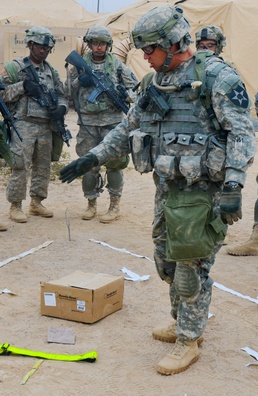
In an effort to teach soldiers realistic combat skills, Headquarters and Headquarters Company, 3-2 Stryker Brigade Combat Team, 7th Infantry Division, rehearsed for a mass casualty event while training at the National Training Center on Fort Irwin, Calif., Jan. 26.
The term mass casualty refers to an event where the ability of available medical resources to respond is exceeded, according the 3-2 SBCT brigade surgeon, Maj. Evan Trivette.
This is the second time that the company has rehearsed for a large-scale casualty-causing event since they arrived at NTC earlier this month. This rehearsal primarily focused on familiarizing soldiers with collections, casualty collection points and medical evacuation routes.
“It gives us the ability to move our casualties if we receive, lets say, indirect fire or anything that could produce a significant number of casualties,” 1st Sgt. Anthony Lockett, HHC first sergeant, said of the training. Indirect fire refers to attacks conducted over long distances by weapons such as mortars or artillery.
“For those that are out there, both in this perimeter and fighting to our left and right sides, medical care is important and knowing how to do this will help sustain life,” Lockett said. “The training that they get here, the rehearsal that we get here, will help better prepare them.”
For Trivette, a Hinesville, Ga., native, the training provides insight into the preparedness of the soldiers that he relies on to provide immediate aid in the event of a mass casualty.
“The purpose of any casualty event, particularly mass casualty exercises, it to increase the readiness and get the units to where they’re prepared to make life and death decisions instantaneously,” he said. “We rehearse for a bad day so that the outcomes are better.”
The challenges of a mass casualty event are numerous and complex.
“It’s very physically demanding and decisions that are made in a second have lasting ramifications,” said Trivette.
Quick care, like in any medical emergency, is especially important, although it can be difficult to provide when there are numerous casualties.
“The greater the immediacy and response, the better the outcome,” Trivette said.
Although medical personnel like Trivette will provide the majority of the care to casualties, it is still important for all soldiers to know how to respond.
“Everybody should have some level of training,” said Trivette. “It’s an essential and integrated part to any unit’s mission.”
Although every soldier hopes that they will never have to use this training, the importance of it is hard to argue. In a dangerous world, it’s always better to be prepared.