KUWAIT - “Doc, Doc I need help,” he shouts.
The young specialist jogs down the narrow hallway, holding his finger and yelling.
He knocks on the door labeled ‘Sick Bay’ as he holds his finger tightly, blood drips from his hand to the gently rocking floor below.
The young female medic opens the door almost immediately, despite the late hour, and quickly assesses the injury while the soldier explains how it happened.
She opens the door wider revealing a few personal possessions, a neatly made bed and an open closet filled with medical supplies which she begins sorting through, grabbing what she needs to treat her patient.
She begins cleaning and bandaging the wound, working quickly and apologizing to the soldier for any pain he may feel.
“You’re always on call when you’re a boat medic,” Piening says with a smile.
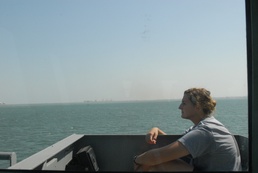
Sgt. Rachel E. Piening, a combat medic and a Cincinnati, Ohio, native, is currently serving as the medic on deck for the United States Army vessel Churubusco, Landing Craft Utility 2013 (LCU- 2013) of the Army Watercraft Company (Provisional) since her deployment in support of Operation Enduring Freedom began July 2013 at Kuwait Naval Base, Kuwait.
Piening, who is part of the medical section of the 371st SB, based out of Springfield, Ohio, is tasked to provide medical support to the crew of the LCU-2013.
Her duties include maintaining medical equipment, diagnosing illness, and treating any injuries while at port and at sea, said Sgt. Kimberly S. Brown, a Brevard, N.C., native, and a medical administration sergeant with the 371st SB.
The excitement of being at sea also provides its own unique challenges to safety and health that surprised the Ohio medic, she said.
“I was just surprised with the types of injuries that can happen with the lines snapping,” she said. “I’m not a boat person, so I was surprised, that doesn’t even go through my mind.”
Working with ropes and nets is a part of the job of a watercraft operator and includes ropes and lines to help anchor the vessel while at port, said Chief Warrant Officer 2 Michael J. Byrne, the vessel master of the LCU-2013 and a Swansboro, N.C., native.
“It (the ropes) can sever limbs, we’re well trained, but the layman might not see the danger immediately,” said Byrne.
Aside from the danger of ropes, burns are another potential risk, due to the chemicals used below deck in the engine room, she said.
“Dealing with fuel, diesel and different chemicals makes it a real risk,” Piening said.
While Piening is always on call, she is often on deck during loading and unloading cargo, and participates in the frequent safety drills that the vessel conducts on a regular basis, she said.
“They do abandon ship drills, fire drills and things like that about once a week; so, it’s been important for me to participate and not only see what they do, but also to learn my role in the drills,” Piening said.
Despite the challenges of working as a medic on an Army watercraft vessel, Piening is grateful for the opportunity to not only experience a life at sea, but also to broaden her horizons and knowledge as an Army combat medic.
“It’s been a huge learning experience, I love going out and learning what they’re doing,” she said. “The best part is that it’s a whole new experience, I’ve never done anything like this.”