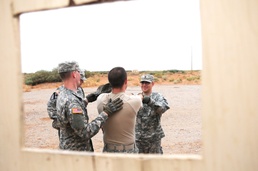
MCGREGOR RANGE COMPLEX, N.M. – Clouds and a little drizzling rain posed no threat to the training mindset of U.S. Army Reserve soldiers and Canadian Forces Military Police gathered for restraints training as part of Exercise Guardian Justice at McGregor Range Complex, N.M., July 19, 2013. The training, organized by the 11th Military Police Brigade and sponsored by the 200th Military Police Command, is designed to prepare participants for real-world scenarios they could encounter during detainee operations.
“Restraints help us keep positive control of detainees and help us keep a safe environment for the detainees, as well as the MPs,” said Cpl. Dani Tzoweh, a Canadian MP with the 2nd MP Regiment, Ontario, Canada.
The training began with demonstrations on proper techniques provided by observer controller trainers, or OCTs, prior to a hands-on portion where participants could practice techniques. Using a makeshift outdoor detention area consisting of only freestanding, wooden cell doors, MPs practiced the three main components of restraints training: how to properly restrain, search and escort a detainee.
The MPs were given a multitude of examples of things that could go wrong if any of the procedures aren’t closely adhered to.
“Out of the three main components of this class, there’s one key point in each,” said Cpl. Austin Kastl, an OCT with the 414th MP Co., in Joplin, Mo. “The proper technique with cuffing will help you avoid injuries both to you and to the detainee.
“Searches need to be thorough and systematic, making sure you do search everything and don’t skip over anything. If you miss an area and you miss it a lot, detainees will pick up on that,” said the Bartlesville, Okla. native
Through each walkthrough, with calm, yet stern commands, MPs properly restrained their comrades, escorted them through their makeshift prison cell door and searched them for contraband.
“When escorting, you want to have positive control [of the detainee],” said Kastl.
The process was practiced several times, to reinforce the three main components.
“This training is beneficial,” said Pfc. Hoang Tran, with the 224th MP Company out of Scottsdale, Ariz. “The only way we can get really good at something is to practice, practice, practice, until it becomes muscle memory.”
The muscle memory helps MPs during the fast-paced and highly intensive culminating training event, or CTE. The CTE is an end-of-exercise event designed to immerse troops in real-world situations that forces them to use all the skills they’ve learned throughout the duration of Exercise Guardian Justice. Scenarios used during CTE generally meet or exceed the stress level of what a troop would experience downrange.
“I believe this training is very accurate to what goes on in real life,” said Kastl. “It gives [participants] a good base or foundation for them to build upon with pre-mobilization training, and possibly more annual trainings before they get deployed.”