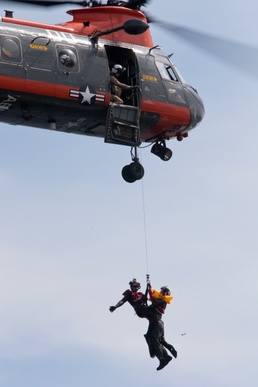
MARINE CORPS AIR STATION CHERRY POINT, N.C. - Marine Transport Squadron 1 conducted crew resource management and emergency egress procedures training in the Neuse River as a part of annual training requirements July 9.
The training covered what squadron personnel are supposed to do after exiting an aircraft in an emergency. Each aircraft took one swimmer and a group of six other Marines to exit the aircraft into the water.
Two Cherry Point emergency services boats, two Navy boats from the Cherry Point Navy boat docks and Aquatic Survival Training Center personnel were on hand at the drop zone as observers, safety standbys and equipment facilitators.
The squadron employed an HH-46E Sea Knight search and rescue helicopter to drop personnel into the water in a maneuver called a five-and-five, where the aircraft moves at five nautical miles per hour, five feet above the water.
Once the Marines and Sailors entered the water, rescue swimmers organized and directed personnel to one of two safety rafts.
While the first team of Marines and Sailors clambered aboard the safety rafts, the helicopter returned to Cherry Point retrieve the second. The Marines and Sailors rotated through six teams. Each team had one rescue swimmer to guide them through the scenario.
When the third team dropped into the water, first team re-entered the water under the powerful rotor wash of Pedro’s propellers to practice live hoisting training before returning to Cherry Point.
“We don’t get to do as many swimmer operations as we would like to,” said Cpl. Kyle Smith, a search and rescue swimmer with VMR-1. “We do it more than a typical Naval operating squadron, but swimmer operations and boat operations are one of the more dangerous and most difficult things we do. So the more we do it and more proficient we are, the more we are able to assist the community and downed aviators.”
Smith was one of the primary observers during the training scenario. In the last year, Smith has personally helped double the number of rescue swimmers in the Marine Corps from three to six with one in training.
Smith said the training benefited all facets of operations. The rescue swimmers, crew chiefs, pilots and teams in the water all got the feeling of what it is like to be a part of a search and rescue endeavor. Having experience, hands-on training and being properly educated gives search and rescue personnel a solid foundation to apply to future real-world experiences.