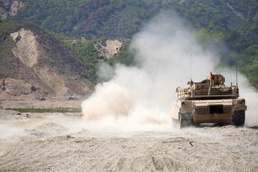
SOUTH KOREA - As the thunderous boom echoed and the round sliced through the air towards its target, the gunner waited in anticipation, eager to know how well he shot.
Republic of Korea and U.S. Marines conducted a bilateral live-fire tank shoot April 25 at Suseong-ri Firing Range as part of the Korean Marine Exchange Program 13-7.
KMEP 13-7 is one of three KMEPs that took place during the exercise Ssang Yong 13. The exercise is defensive in nature, and is designed to exercise the interoperability of the ROK and U.S. forces.
The ROK and U.S. Marines convoyed from 1st ROK Marine Division Base to Suseong-ri Firing Range near the city of Pohang in their tanks, using natural roads as well as dried-out river beds April 22. The ROK Marines drove K1 88-tanks, while the U.S. Marines operated M1A1 Abrams tanks.
"It's not very often that we're allotted the opportunity to convoy through urban terrain with our tanks," said Sgt. Robert A. Jewb, a tank commander with Company A, 4th Tank Battalion, 4th Marine Division, Marine Forces Reserve. "It's a great experience for our drivers as well as the tank crew."
“It takes the entire crew to ensure that the tank makes it to its destination safely due to the fact that the tank driver uses a sight to see and can't see everything around them, so they have to utilize their crewmen," said Jewb.
The ROK and U.S. Marine tank units conducted bilateral live-fire training from April 23 to April 25 at Suseong-ri Firing Range.
"Working with tanks is a great experience," said Sgt. Melvin Calander, an M1A1 gunner with the company. "It's an adrenaline rush when you fire a tank. Your heart starts pumping fast as you get ready to fire, and when it goes off it feels like your heart skips a beat."
Along with firing the primary cannon of the tank, the Marines would also use the M2 .50 caliber machine gun and M240B medium machine gun which are mounted on top of the tanks.
"The bilateral training course of fire consists of two tank teams from both the ROK and U.S. Marines firing and moving towards a set of targets," said Calander. "The ROK team would fire one round after the other followed by the U.S. tank teams. After firing two rounds each, the tanks would move towards their target until they reached their next firing point and fire two more rounds each. After each tank had fired a totaled of four rounds they would then assault their way to the target by using the machine guns mounted on the tanks."
As the tank training came to an end and the dust settled from the last round fired, the ROK and U.S. forces held a closing ceremony in which the commanding officer of Company A, 4th Tank Battalion presented the commander of the ROK battalion with a plaque to thank them for all the training that was conducted as well as their hospitality. Additionally, both the ROK and U.S. Marines listened to a closing presentation from the commanding general of III Marine Expeditionary Force, Lt. Gen. Kenneth Glueck.
"The training that is conducted between the ROK and U.S. forces strengthens the interoperability between us," said Glueck. "We have to be ready to deploy at all times, for any and everything, and the only way we can ensure that is to train in different environments and stay efficient to ensure unit readiness."