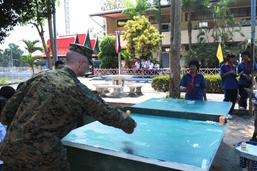
CHONBURI PROVINCE, Kingdom of Thailand – U.S. Marines and sailors along with Royal Thai Navy sailors were welcomed to Nikom School in Chonburi province, Kingdom of Thailand, with a balloon archway, colorful beaded necklaces and cool beverages Feb. 19.
The U.S. Marines and sailors visited the school as part of exercise Cobra Gold 2013 to build relationships with members of the local community.
“I felt so honored and welcomed when I arrived and was given a necklace,” said Petty Officer 1st Class Laurie Washington, a logistics specialist with Combat Logistics Regiment 3, 3rd Marine Logistics Group, III Marine Expeditionary Force.
Students from pre-school to middle school, filed into an outdoor auditorium to meet the Marines and sailors, excited at the opportunity to mingle with people from another place with a different culture. Cultural exchanges began with three students dressed in brightly colored traditional Thai dress and performing a dance with dried flowers.
“I have never seen a traditional Thai dance before,“ said U.S. Marine Lance Cpl. Jake Ethier, a member of CLR-3. “I enjoyed the show they put on for us and did not realize how young the girls learn the traditional dance.”
U.S. Marines provided a cultural show of their own by executing close order drill movements, which is one of the cornerstones of Marine Corps customs, courtesies and traditions. These traditions are perpetuated from one generation to the next through constant use and practice.
“Marines, dress right, dress!“ commanded U.S. Marine Staff Sgt. Floyd Celestine, a member of CLR-3.
Two reasons for close order drill are to enhance leadership and instill discipline. Close order drill is one foundation of discipline and esprit de corps.
“I have never seen anything like this,” said, a Nikom School teacher. “I know the children are too young to appreciate the discipline of the Marines, but I understand.”
Students and their teachers, U.S. military members and Royal Thai sailors divided into four groups for another culture exchange – meals ready-to-eat.
U.S. Marines shared the contents of the MRE’s with the students and teachers, even Royal Thai sailors sampled the goodies found in the brown meal packets.
Celestine demonstrated the way he makes a sports drink using the orange powdered beverage mix included in the MRE and water. The students were amazed by the taste.
“This is good,“ said Amani, a student at the school.
Later, a field day of games was started with tug-of-war. U.S. Marines and sailors along with Royal Thai sailors competed against the students. In the end, the students’ came out on top, winning two of the three games.
“It was us against all of them,” said Lance Cpl. Joseph McCusker, a member of CLR-3. “We gave them a headstart and they beat us!”
Basketball, soccer and volleyball were the other games played with the military members and the students. Many students and teachers participated in the activities, while others sat in the shade cheering for their friends or joined in other activities.
Petty Officer 2nd Class Michael Davis, a hospital corpsman with CLR-3, enjoys art and teaching. He mentored a table of future artists, painting small ceramic animals on paper using watercolors.
“I enjoy showing young people how to draw,” said Davis. “Every Saturday, I used to teach drawing to young people at the Boys and Girls Club in the states.”
Davis’ teaching ability became evident when a young student was able to recreate the same dog and cat drawing he had demonstrated.
A typical Thai lunch was provided for the military members, allowing the students to dine with their new friends.
“I am glad the Marines are eating Thai food instead of MREs,” said Thorand. “They should enjoy the cuisine while they are here.”
When it was time to leave, the students were sad about the military members’ departure, but they were happy to have had the opportunity to interact.
“I enjoyed the interaction with the children, “ said Washington. “I can not believe the level of enjoyment we had playing with them.”
CG 13, in its 32nd iteration, is designed to advance regional security and ensure effective response to regional crises by exercising a robust multinational force from nations sharing commons goals and security commitments in the Asia-Pacific region.