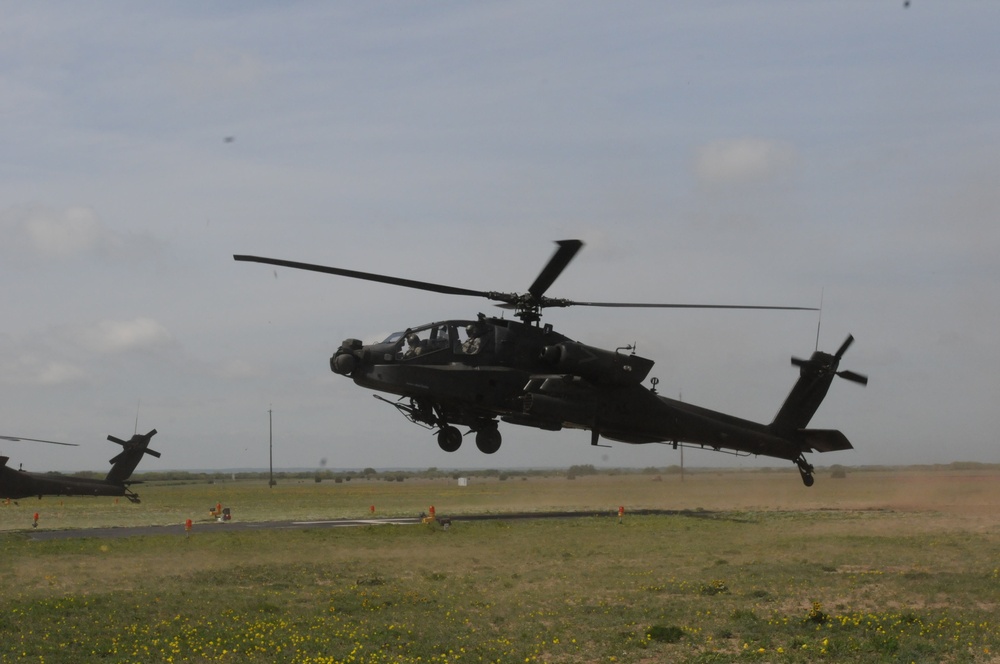
BRADY, Texas - Aircrews flew and support operations staff scrambled as the skies over the small city of Brady played host to a battalion of Longbow Apache attack helicopters from the Utah Army National Guard recently, in a display of readiness for deployment to Afghanistan.
The nearly 350 soldiers of the 1st Battalion, 211th Aviation Regiment have been training at Fort Hood, Texas, since mid-January and will depart in support of Operation Enduring Freedom in early May.
For the soldiers of the 1-211th Attack and Reconnaissance Battalion, this aerial operation was the last in a series of five training phases, the first of which began 21 months ago. The eight-day exercise replicated how the 1-211th ARB will perform its daily missions in Afghanistan, and the soldiers’ performance here will determine if the unit will be certified as combat-ready.
The 1-211th ARB is but one of the Army reserve component units that has undergone rigorous preparation for deployment under the watchful eyes of trainers from First Army Division West’s 166th Aviation Brigade and U.S. Army Forces Command’s 21st Cavalry Brigade, two organizations with the capability of training aviation units across the full spectrum of military aviation operations.
At Fort Hood, the 166th Aviation Brigade and the 21st Cavalry Brigade work together to ready Army National Guard and Army Reserve Longbow Apache units for combat.
According to 166th Aviation Brigade commander, Col. Lawrence Madkins III, the missions of the two training organizations are complementary, but not identical.
“The major difference between the two brigades is the 166th Aviation Brigade is focused exclusively on reserve component training, validation and deployment,” Madkins said. “The 21st Cavalry Brigade executes a multitude of missions – equipment fielding and training for active and reserve component units, foreign military sales and other missions as directed by FORSCOM.”
In its role as a trainer, the 21st Cavalry Brigade's mission is to ensure units such as the 1-211th are properly equipped and trained on new systems, according to 21st Cavalry Brigade commander, Col. Neil Hersey.
“We conduct collective training to certify the unit as combat-ready. The 166th Aviation Brigade validates these same units to guarantee they meet all specified theater deployment requirements,” Hersey said. “Together, we certify and validate these units at the same time.”
Soon-to-deploy Chief Warrant Officer 2 Carl Spear, from Alpha Company, 1-211th ARB, is a maintenance test pilot who manages maintenance and troubleshooting of aircraft, and conducts ground and flight evaluations of the aircraft when problems arise or after they have been repaired. He said the training provided by Division West and the 21st Cavalry Brigade has provided unanticipated problem-solving opportunities for the soldiers of his unit.
“Some things threw us for a loop, but we were able to adapt and learn from what they gave us,” Spear said. “They are giving us tools to put in our tool bag to enable us to accomplish our mission when we actually go in-country. I’ve been really impressed with the amount of effort they’ve put into it. You can tell there’s been a lot of effort made to make the training challenging and realistic.”
The two training organizations follow the Unit and Fielding Training Program, a five-phase operation, to prepare units for proficiency in combat tasks over time. The UFTP begins 18 months before an aviation unit arrives at Fort Hood and concludes when the unit deploys.
“Phases I and II are conducted at the unit’s home station. They include individual and crew training,” Hersey said. “We send a team to observe and support individual training and maintenance tasks as the unit receives its new aircraft. We provide instructor pilots and maintenance examiners during Phase I to qualify the unit's pilots.
“Phase II is gunnery and crew training,” Hersey continued. “Each company battle rosters their aircrews and individually qualifies each. Phase III is crew training that focuses on company level operations. Phase IV is an eight-day battalion-level exercise that trains all mission tasks, maintenance operations and logistical support, similar to how the unit will execute daily operations while deployed.”
Phase V of the UFTP concludes with the 1-211th’s performance in Brady, which is assessed by evaluators from FORSCOM. These soldiers were selected as evaluators because of their experience in real-world deployments similar to the one for which the 1-211th is preparing. They follow support staff on the ground, as well as taking to the skies to observe the Apache pilots’ performance while airborne.
“The Longbow Apache is the world's most advanced attack helicopter,” Hersey said. “The Apache is a major combat multiplier on today's battlefield and plays a critical role in Army aviation's future mission successes.”
Most pilots and crewmembers love flying, Madkins said.
“I can't say I've ever heard anyone complain,” Madkins added. “Flying is very cool. It is even more so when you fly a scout or attack aircraft and get to perform those missions.”
| Date Taken: |
04.03.2012 |
| Date Posted: |
04.03.2012 14:04 |
| Story ID: |
86183 |
| Location: |
BRADY, TEXAS, US |
| Web Views: |
328 |
| Downloads: |
0 |
PUBLIC DOMAIN

This work, Division West, 21st Cav Bde trainers put attack aviators to test, by Mark Kalinoski, identified by DVIDS, must comply with the restrictions shown on https://www.dvidshub.net/about/copyright.