by Sgt. Chris Jones
Desert Voice Staff Writer
40th PAD
CAMP ARIFJAN (October 4, 2006) --- There have been many great pictures taken of operations in Iraq and Afghanistan, but the one commanders want – and need – can't be found in magazines or newspapers.
The Global Command and Control System is what the military uses to see the battlefield – via satellite, the GCCS offers a visual map of the battlefield, which tells commanders where servicemembers are and what they are doing, said Air Force Staff Sgt. Michael Harvell, an instructor for the system.
"Basically, you can view everything in the [area of responsibility]," Harvell said. "You could actually see the entire world, but you wouldn't want to do that – it would be too much information."
Currently, Harvell and a team of more than 20 GCCS instructors are deployed to Camp Arifjan, Kuwait, to teach servicemembers and civilians on the GCCS.
The instructors are members of the 333rd Training Squadron, based out of Keesler Air Base, Miss. The team of instructors also includes contractors and Department of Defense civilians.
Although they are based in Mississippi, they travel all over the world for training. In the last few years, Harvell and his team have been to Colorado, Florida and Hawaii, as well as Germany, Japan and South Korea, on training missions.
"This will be used by the entire military as their command and control system," Harvell said.
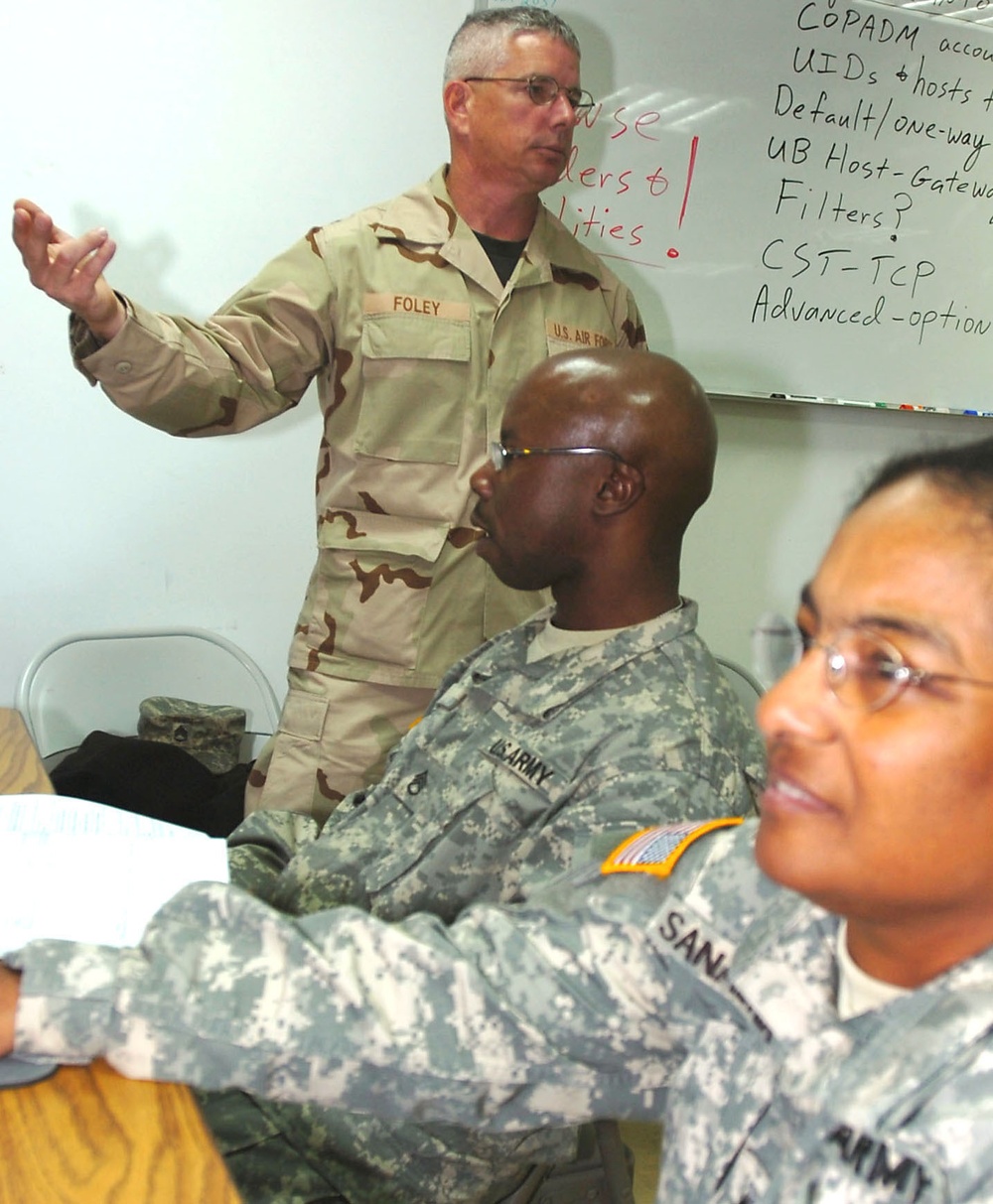
Harvell and Master Sgt. Steve Foley are members of the 333rd Training Squadron, and have worked together for more than four years. Both said they have enjoyed being able to work with USARCENT in Kuwait.
"Before we got here, we only had one Army guy and one Marine in our class," said Harvell. "I like working with other services, and it's good because we're all using this system."
Classes are divided into two levels. Both are two weeks long, but Level Two teaches students how to set up the GCCS system.
Because Air Force instructors are required to have at least an associate's degree, and because GCCS courses are accredited by the Community College of the Air Force, college credits are awarded to graduates, said Harvell. The GCCS works with the Blue Force Tracker to allow commanders to be constantly aware of where their troops and valuable assets are on the battlefield.
Blue Force Tracker is essentially the forward element of the system, allowing GCCS operators to manage from a distance, said Harvell. Vehicles in Iraq and Afghanistan are now equipped with BFT, making GCCS the perfect tool for staying connected with the troops in these vehicles.
With GCCS, the military can track valuable military assets, provide emergency communication, and allow search and rescue forces to quickly locate, identify and communicate with at-risk personnel.
"If you were in charge of running a war," said Harvell, "you would want the latest and greatest information as to where your assets are on the battlefield, and this gives you that."
| Date Taken: |
10.04.2006 |
| Date Posted: |
10.06.2006 09:41 |
| Story ID: |
7938 |
| Location: |
CAMP ARIFJAN, KW |
| Web Views: |
97 |
| Downloads: |
18 |
PUBLIC DOMAIN

This work, Joint system training enhance situational awareness in combat, by SGT Christopher Jones, identified by DVIDS, must comply with the restrictions shown on https://www.dvidshub.net/about/copyright.

 Subscribe





