
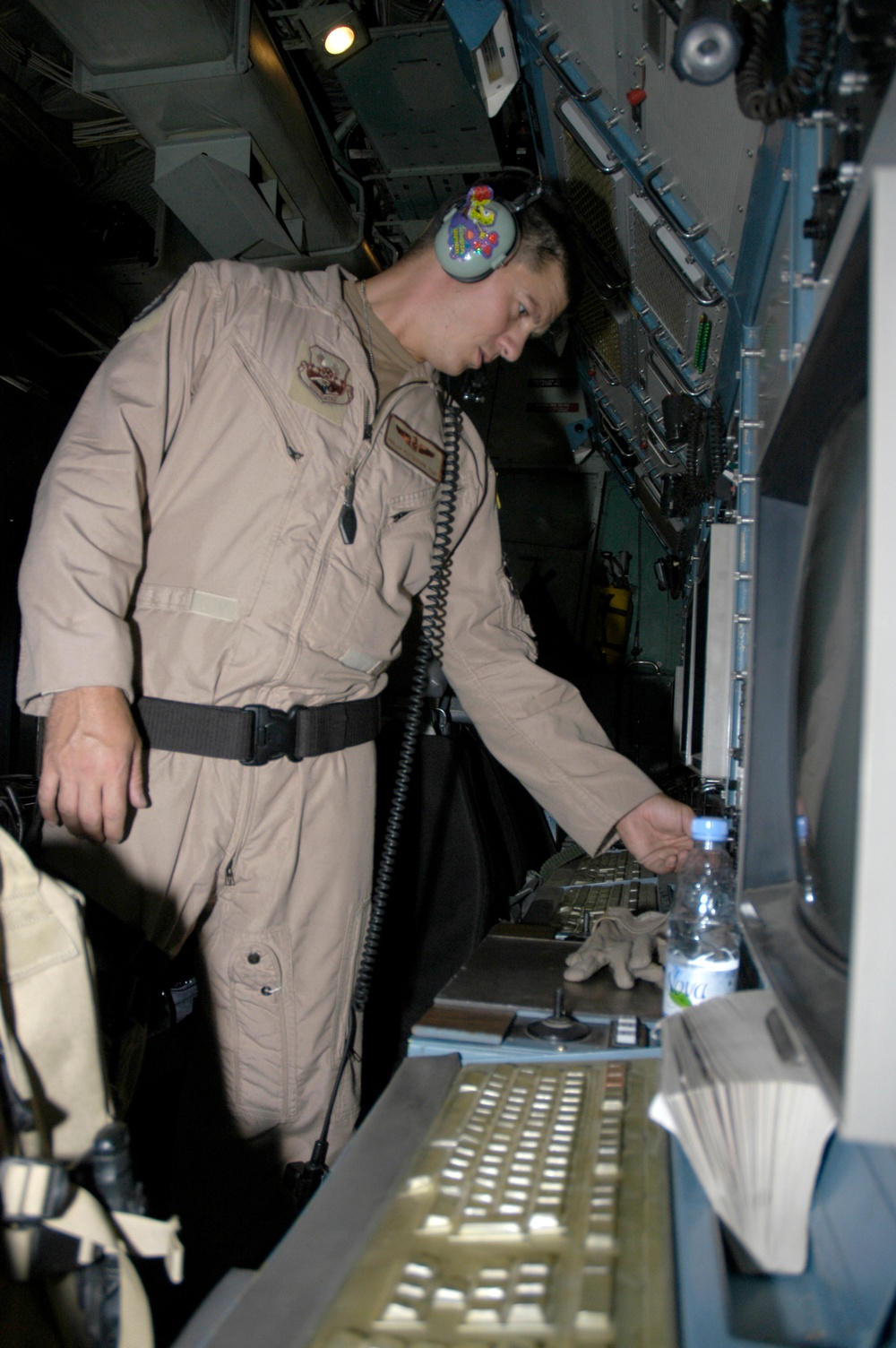
Courtesy Photo | Tech. Sgt. Phillip Patterson, a mission crew supervisor with the 43d Expeditionary...... read more read more
 Subscribe
By Staff Sgt. Ryan Hansen,
386th Air Expeditionary Wing
SOUTHWEST ASIA - Their mission statement is simple – save the lives of troops on the ground in Iraq by providing an electronic shield around them.
That's the job of the 43rd Expeditionary Electronic Communications Squadron in a nutshell. Everyday of the week the Bats, as they are known, take to the air to actively support coalition war fighters in harm's way by providing electronic combat coverage.
As one of only two electronic communications squadrons in the Air Force, the 43rd EECS' special skills are in high demand. They, along with their sister squadron, the 41st EECS, are part of the 55th Electronic Combat Group at Davis-Monthan Air Force Base, Ariz., and have been continuously deployed to the AOR since Spring 2004.
"I'm incredibly proud of everybody here with us," said Lt. Col. Steve Miller, 43rd EECS commander. "We have guys that have been deployed here four and five times now and their dedication to the mission is just amazing to me."
While the 41st EECS is responsible for Operation Enduring Freedom, the 43rd EECS takes care of Operation Iraqi Freedom.
"We work with three major divisions on the ground: the 1st Marine Expeditionary Force and the Army's 101st Airborne and 4th Infantry Division," he said.
A typical mission for the 43rd EECS consists of eight-to-nine hours of flying high above the Iraqi ski. While in the air they respond to joint tactical air strike requests, which basically tell the Bats where their help is needed.
"Through JTASRs they tell us where, when and what they need to have targeted," Miller said.
And the numbers don't lie. So far this year the 43rd EECS has supported more than 1,125 JTASRs and last year they answered more than 1,500 requests.
"It's known as electronic close air support or non-kinetic CAS," said Maj. Arvid Opry, 43rd EECS director of operations. "Basically we are providing a protective shield for 150,000 ground troops and Iraqi civilians."
Although the requests are large, the number of personnel and aircraft in the squadron is relatively small. The 43rd EECS maintains a high mission effectiveness rate by relying on roughly 35 operations personnel and about 35 maintenance troops, who are from the Red Aircraft Maintenance Unit of the 386th Expeditionary Aircraft Maintenance Squadron.
"The mission we do here is really motivational," said Capt. Joe Schmidt, Officer in Charge of Red AMU. "We have a lot of guys that are here for their third or forth time and even with that much time away from their families, they still love to come over here and do this."
The 43rd EECS operates a fleet of EC-130H Compass Calls to accomplish their important mission. At first glance these aircraft appear to be the same as the rest of the Rock's C-130, however they are not. The crew on board uses this heavily modified airframe to disrupt enemy command and control communications.
"The antennas really stand out, especially the one they call the cheese cutter," Miller said. "Basically from nose to tail we have receiver antennas and jamming antennas that help us do our mission."
Through all the deployments and long work hours, including more than 320 sorties this year including more than 2,600 combat flying hours, it's supporting the forward deployed troops that keep Airmen of the 43rd EECS motivated to get the mission done.
"The biggest thing for me is the team effort I see out here," Schmidt said. "We've got guys who normally work in the back that wouldn't have anything to do with us, but here they want to step in and help where they can."
"When people come to the squadron they're aware of our ops tempo," Opry said. "And at the three year point they can shift out, but most of them stick with it. To me that really shows the dedication they have to the mission and the squadron."
| Date Taken: | 08.15.2006 |
| Date Posted: | 08.15.2006 09:17 |
| Story ID: | 7442 |
| Location: | (UNDISCLOSED LOCATION) |
| Web Views: | 183 |
| Downloads: | 105 |

This work, The Bats, must comply with the restrictions shown on https://www.dvidshub.net/about/copyright.


No keywords found.




