
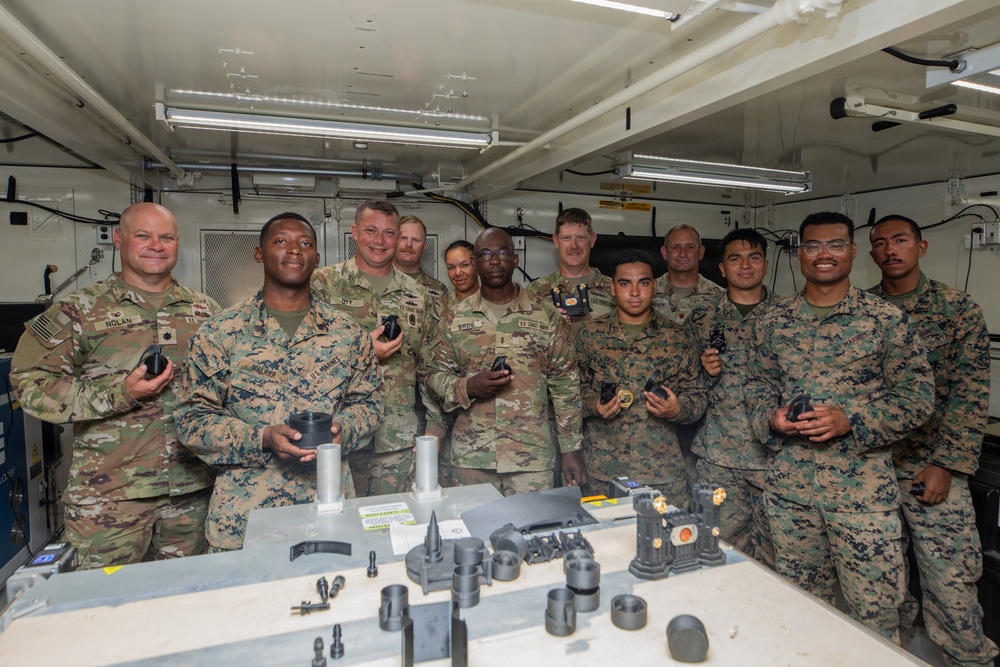
Photo By Lance Cpl. Marcus Henson | U.S. Marines with 3rd Maintenance Battalion, Combat Logistics Regiment 35, 3rd Marine...... read more read more
 Subscribe
POHANG, South Korea – U.S. Marines with 3rd Marine Logistics Group utilized advanced manufacturing capabilities to produce a replacement component for a U.S. Coast Guard watercraft during the Combined Joint Logistics Over-the-Shore 26 exercise in Pohang, South Korea, July 11, 2026.
While conducting CJLOTS, an exercise designed to train U.S. and Republic of Korea forces in the transfer of personnel and equipment from sea to shore in austere environments, a Coast Guard vessel required the replacement of a specific part that was not immediately available through standard supply channels. Marines with 3rd Maintenance Battalion, Combat Logistics Regiment 35, 3rd MLG, equipped with expeditionary fabrication systems, were then tasked with providing a solution.
"There is a demand to decrease the supply deficiencies and backorders in order to increase repairs and replenish items quickly," said Chief Warrant Officer 2 Jonathan B. Salas, utilities officer for Regional Maintenance Operations Company North, 3rd Maintenance Battalion. "Advanced manufacturing is one answer to solve this problem set. In this case, we cut a potential two- to three-week shipping delay for a replacement part down to just a few hours. The replacement part itself cost about $12 to print, the same as the original, but we have the option to use a cheaper filament that would cut the cost by another $4 without sacrificing performance."
Operating out of an Expeditionary Fabrication Facility, or X-FAB, the Marines 3D-printed the replacement part by reverse-engineering the original piece in their design systems. Following minor adjustments, the final printed part was installed and functioned effectively, allowing the watercraft to resume its role in the combined exercise.
"The immediate effect that the 3D-printed part provided to the mission was expediting the continued use of the Coast Guard’s rigid-hull inflatable boats, valued at around $600,000 each," Salas added. "This allowed the Coast Guard to operate quick-reaction-force and patrol missions, ensuring the security of the surrounding waters for CJLOTS."
"The first prototype was a success; they were taken aback by the fact that a part such as their strainer can be reverse-engineered and 3D-printed in full in less than half a day," said Cpl. Kenzie Gallang, a metal worker with the battalion.
This application of advanced manufacturing demonstrates a practical method for the ROK-U.S. alliance to mitigate supply chain delays. By producing required components on-site, combined joint forces can maintain equipment for operational readiness in expeditionary environments without relying exclusively on traditional logistics nodes. The ability to share these sustainment solutions across service branches and allied nations significantly increases operational flexibility.
"We are demonstrating how nontraditional manufacturing methods, even in an expeditionary environment, can produce parts of consequence to improve the readiness across the joint force," said Col. Robert Fairley, commanding officer of Combat Logistics Regiment 35.
The integration of 3D printing capabilities during CJLOTS 26 directly supports the exercise’s objective of enhancing readiness and U.S.-ROK bilateral interoperability. Validating these tactical-level sustainment capabilities ensures combined allied forces can maintain momentum, sustain shared logistics requirements, and remain stronger together as an alliance on the Korean Peninsula.
| Date Taken: | 07.25.2026 |
| Date Posted: | 07.26.2026 04:45 |
| Story ID: | 570729 |
| Location: | POHANG, KR |
| Web Views: | 29 |
| Downloads: | 0 |

This work, Advanced manufacturing supports joint and bilateral readiness at CJLOTS 26 in South Korea, by 2LT Cooper Haseley, identified by DVIDS, must comply with the restrictions shown on https://www.dvidshub.net/about/copyright.

No keywords found.




