
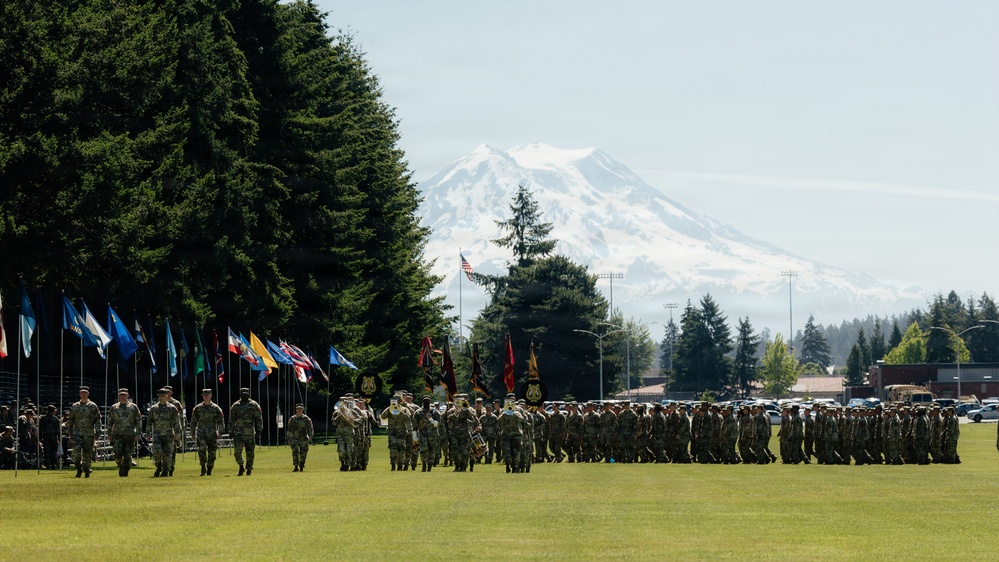
Photo By Staff Sgt. Cayce Watson | Soldiers assigned to 7th Infantry Division (Multi-Domain Command - Pacific) conduct...... read more read more
 Subscribe
Soldiers from the 7th Infantry Division and 1st Multi-Domain Task Force held a redesignation ceremony June 18 at Joint Base Lewis-McChord, to case the 1st MDTF Headquarters and 7th ID Headquarters Support Company colors and uncase the 7th Infantry Division (Multi-Domain Command-Pacific) Headquarters and Headquarters Battalion colors, marking a major organizational shift.
The redesignation honors the Bayonet Division’s legacy while establishing the 7th Infantry Division (Multi-Domain Command-Pacific) as theArmy’s newest theater-enabling command, built to integrate maneuver, fires, air defense, cyber, space, electronic warfare, intelligence, unmanned systems, sustainment, and command and control in support of the Joint Force across the Pacific.
“We are merging the operational endurance, flexibility, and protection of our proven Stryker formations with the long-range sensing and precision fires of our multi-domain task force,” said Maj. Gen. Bernard J. Harrington, commanding general of 7th ID (MDC-PAC).
7th ID (MDC-PAC) is an operational-level formation designed to operate forward, develop situations, disrupt enemy systems, and complicate adversary planning.
It supports the Army’s transformation initiative by unifying 7th ID’smaneuver assets and 1st MDTF’s multi-domain capabilities under one command, streamlining mission command across complex operations.
Central to7th ID (MDC-PAC)is the Cross-Domain Contact Layer, a system that integrates intelligence collection, electronic warfare effects, and artificial intelligence to support rapid command decisions within a continuous operational framework.The CDCL allows forces to disperse over large areas to maintain pressure on adversaries both in close and deep areas.
“Through our emerging Cross Domain Contact Layer concept, our division will employ capabilities such as unmanned surface vessels; long-range, one-way attack drones; and launched effects to penetrate the adversary's anti-access/area-denial network,” Harrington said, “Every radar that emits, every node that transmits, every headquarters that commands, we aim to hold continuously at risk alongside our joint Partners and allies.”
Harrington now leads the Army’s newest multi-domain headquarters, which will refine the CDCL model during upcoming combined, joint and multinational exercises.
The CDCL organizes modern battlefield capabilities into four components: sensors that capture information across land, air, sea, space, and cyberspace; precision weapons paired with affordable unmanned drones; digital networks and software that help leaders make faster decisions; and robust military units able to operate even when disrupted by enemy action.
Harrington stressed that alongside Partners and allies, the division aims to prevent conflict, and the common thread connecting all efforts is the Soldiers.
"Technology does not win wars,” he said, “our people do.”
The ceremony also reflects the Army’s pushto distribute sensing, fires, electronic warfare, space, and cyber capabilities across maneuver formations to increase effectiveness in contested environments.
“Our hourglass patch went to France in World War I and helped defeat the Germans in the largest battle in American history,” Harrington said, noting the division’s long tradition of adaptation, “Later, it trained as a motorized infantry battalion, then amphibious assault, then light infantry. The Bayonets went ashore in the frozen Aleutians in 1943. They fought in the jungles of Laite. In Korea, they landed and fought at Incheon at the Chosin Reservoir, and by the end of that war, had served a staggering 850 days in continuous combat.”
Gen. Ronald P. Clark, commanding general of U.S. Army Pacific, emphasized the division’s commitment to future training and Indo-Pacific readiness.
Clark outlined U.S. Army Pacific's focus: delivering combat-ready forces, strengthening Partnerships and alliances, and advancing innovation to maintain a competitive edge in the Pacific.
“With this transformation, the 7th Infantry Division is poised to plan and execute complex multi-domain operations across this region," Clark added. “Bringing the full strength and resources of a division in support of the joint force.”
These changes build on years of Indo-Pacific experimentation, including 1st MDTF deployments, ground-based long-range precision fires, and combined efforts with regional Partners such as the Armed Forces of the Philippines.
“These Soldiers have invested wholeheartedly in experimenting, deploying, and employing capabilities that work from the heavens to the earth, from the air to the sea, and flow with all the digits that go in between,” said Col. Charles W. Kean,7th ID (MDC-PAC) deputy commanding officer-effects andformer 1st MDTF commander,“It has truly been inspirational to watch them in action.”
He noted that their dedication has propelled the division into its next phase of transformation, adding that this progress is only the beginning as the organization adapts to new operational demands.
“This merger isn't an ending,” Kean said. “It's just another milestone as we continue to move at the pace of relevance. We built something historic, and we're continuing to build something historic, something consequential, and something that could potentially stop the next war.”
| Date Taken: | 06.18.2026 |
| Date Posted: | 06.18.2026 20:21 |
| Story ID: | 568224 |
| Location: | JOINT BASE LEWIS-MCCHORD, US |
| Web Views: | 1,873 |
| Downloads: | 1 |

This work, 7th ID conducts redesignation ceremony, by SFC Monik Phan, identified by DVIDS, must comply with the restrictions shown on https://www.dvidshub.net/about/copyright.


No keywords found.




