
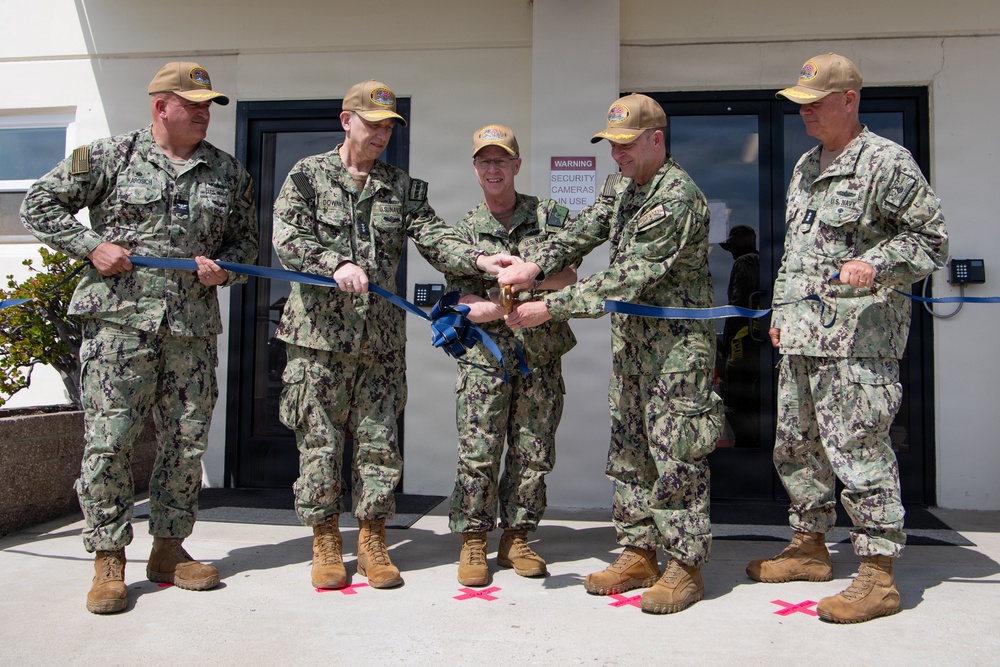
Photo By Petty Officer 1st Class Claire Alfaro | NAVAL BASE SAN DIEGO, Calif. (June 4, 2026) - From left to right, Capt. Brian...... read more read more
 Subscribe
NAVAL BASE SAN DIEGO (June 4, 2026) — The Navy re-established Shore Intermediate Maintenance Activity (SIMA) commands in ceremonies in Norfolk, June 2, and at Naval Base San Diego June 4, 2026.
The re-establishment is part of an effort to increase Navy self-sufficiency by putting maintenance back in the hands of Sailors, empowering their shore tours with hands-on experience, and reducing wait times for intermediate-level maintenance previously performed by contractors.
"The establishment of SIMA as an independent command is more than administrative shift. It is a critical investment in our warfighting readiness, said Vice Adm. Brendan McLane, commander, Naval Surface Force, U.S. Pacific, Fleet. “Tomorrow's tactical advantage is built on today's maintenance foundation. This decision ensures the hard-won expertise of our maintainers is institutionalized for the future."
During the ceremony in San Diego, Chief of Naval Operations Adm. Daryl Caudle cut the ribbon for the new building alongside McLane; Vice Adm. James Downey, commander, Navy Sea Systems Command; Capt. Brian Karosich, commanding officer of Southwest Regional Maintenance Center; and Capt. Bill Albert, who assumed command of SIMA San Diego.
During the ceremony in Norfolk, SIMA Norfolk’s training lab was named for retired Capt. Claude A. “Bob” Butler, Jr. in recognition of his service in command of the original SIMA Norfolk from June 1997 to November 2002.
Capt. Megan Thomas assumed command of SIMA Norfolk. For Thomas, the command represents a fundamental component of the Navy's overall warfighting posture.
"Maintenance is a critical enabler for all other warfare areas," said Thomas. "Without it, we cannot have the confidence that our warships will be able to do what the nation needs them to do."
A major part of the vision for the new SIMAs is providing a dual-focused shore command for Sailors – where they gain essential skills and hands-on experience, and simultaneously operate in a ‘field’ setting—ships in port—to support the maintenance and repair needs that ships cannot conduct on their own.
“When you look at somebody that does a three-year tour here, what we envision is to make sure that we’re getting them the right touch points and building the right skills to give that return-to-sea value,” said Capt. Bill Albert, commanding officer of SIMA San Diego.
SIMA underpins Chief of Naval Operations Adm. Daryl Caudle’s “Foundry” vision of People, Infrastructure, and Materiel as the drivers of naval power.
“Ships do not stay in the fight without skilled maintainers, artisans, and engineers,” said Caudle, who spoke at the ceremony. “They do not sustain combat operations without Sailors who can diagnose casualties, repair systems, restore capability, and solve problems under pressure.”
HISTORY
This is not the first time such a maintenance activity has existed in Navy history. World War II marked the Navy’s realization that the force needed quick-repair capability at the “intermediate” level, the type of maintenance between crew-level and depot-level. At that time, repair ships and fleet support bases, or repair activities, assumed that responsibility.
By the time of the Cold War, these activities had become more permanent shore-based commands, capable of providing repairs to ships both at the pier and on shore, performing necessary maintenance between overhaul periods, and offering a shore billet option for Sailors in maintenance- and sea-duty-heavy ratings.
In 1978, the then-named Fleet Maintenance Assistance Group was redesigned as Shore Intermediate Maintenance Activity San Diego - the first use of the name.
These ‘new’ commands, SIMA San Diego and SIMA Little Creek, made it possible for the Navy to be its own source of intermediate maintenance availabilities, the maintenance periods between deployments that kept ships functioning properly between longer overhauls. In addition, the Sailors at SIMA gained maintenance experience they would not have had the opportunity to gain while aboard a ship on deployment. This experience helped the Navy produce technical experts within its own ranks, contributing directly to Naval self-sufficiency.
After the Cold War, though, the demand for intermediate maintenance began to wane, and SIMAs were consolidated into Regional Maintenance Centers, such as Southwest Regional Maintenance Center San Diego (SWRMC).
However, the closure of SIMA again meant fewer hands-on shore billets for those in maintenance ratings and less intermediate maintenance conducted by Navy Sailors on Navy ships. Today, it is time for Sailors to have that ability again.
MOVING FORWARD
“SIMA is here to develop the Sailor to be more self-sufficient, more technically sufficient, and to help get after repairs,” said Albert. “So, for every Sailor coming to SIMA: understand that we’re here to develop you and your skills, that you’re not going to be in one shop and forgotten about. Expect to be more repair-minded per your rate as you transition through the process.”
SIMAs are the foundry platforms where technical mastery is formed, ships are sustained, and readiness directly impacts operational capability. They are where Sailors master the skills to keep combat power on station.
“Who cannot get behind developing Sailors?” said Albert. “I think everyone can rally behind that and develop Sailors properly. You’ll see the payback in the future as they return back out to the fleet with the capabilities and skills that they have.”
For both the East and West coasts, intermediate maintenance in the hands of Sailors means shorter availabilities, lower total costs of readiness, and higher quality work the first time.
“The reality is this: In the next fight, we cannot assume there will be a safe harbor, a contractor waiting on the pier, or the luxury of time. We need crews capable of diagnosing problems, restoring systems, adapting to damage, and sustaining combat power under pressure and under attack.” said Caudle.
In the future, Thomas looks forward to showcasing the great work Sailors can do when given the tools and opportunity to help build combat-ready forces.
Albert looks forward to seeing Sailors grow. “It’s making sure that we’re delivering on what we say we’re going to do, and that’s an entire team effort. I’m looking forward to the continued ability to work with Sailors...righting the ship when it comes to Sailors and their development.”
As the Navy’s self-sufficiency continues to grow, Thomas added that SIMAs will continue to be looking for Sailors who are eager to learn and want to make a difference for the fleet, saying “there is no better place to build your skills and have a meaningful impact while on recharging shore duty.”
| Date Taken: | 06.05.2026 |
| Date Posted: | 06.05.2026 20:05 |
| Story ID: | 567018 |
| Location: | SAN DIEGO, CALIFORNIA, US |
| Web Views: | 360 |
| Downloads: | 0 |

This work, Shore Intermediate Maintenance Activities Norfolk and San Diego Re-Established, by PO1 Claire Alfaro, identified by DVIDS, must comply with the restrictions shown on https://www.dvidshub.net/about/copyright.


No keywords found.




