
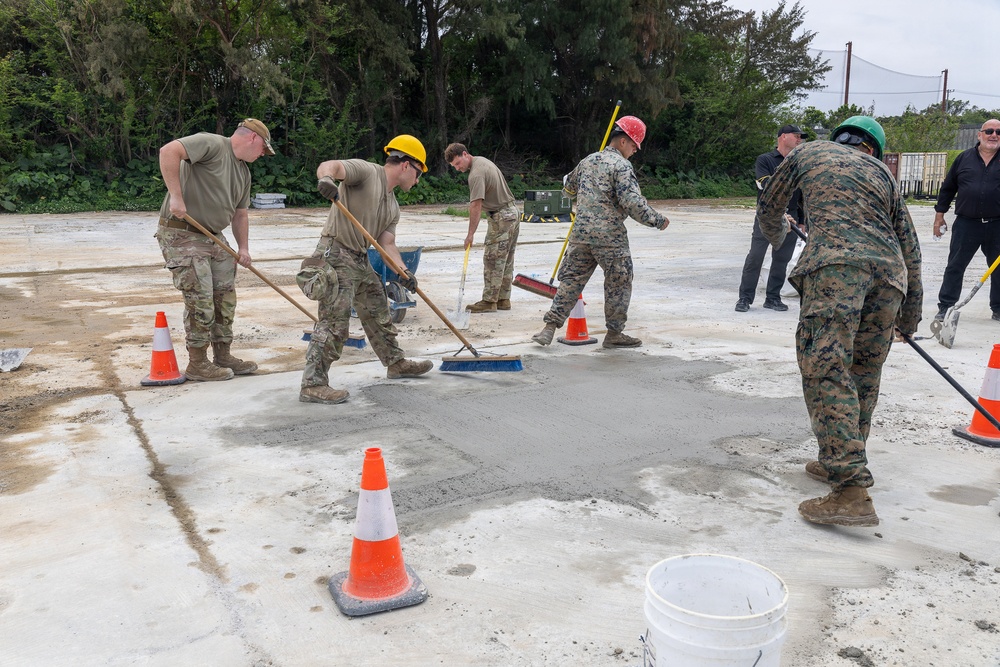
Photo By Cpl. Jeremiah Barksdale | U.S. Airmen with the 18th Civil Engineer Squadron, 18th Wing and U.S. Marines with...... read more read more
 Subscribe
CAMP FOSTER, Japan – Preparation is a pillar of the Marine Corps. Marines remain ready for any challenge that may arise, and they continue to anticipate future friction points. On 14 – 16 April, Defense Logistics Agency (DLA) and 1st Marine Aircraft Wing (MAW) demonstrated an innovative evolution in airfield damage repair (ADR).
This collaboration exemplifies training designed to rapidly test new technologies in realistic environments, generating critical data and closing the gap between research and development (R&D), and deployment.
DLA’s J68 Research and Development office, and the Troop Support Construction & Equipment (C&E) Directorate, spearheaded the initiative, and emphasized placing early-stage prototypes directly into the hands of the warfighters who will use them.
"We field prototypes in operationally realistic environments to enable rapid adaptation," stated Mr. David Koch, director of DLA J68 R&D. "This generates immediate value through operational use and allows us to refine capabilities based on direct feedback from those who will deploy them in dynamic combat environments."
Direct feedback from Marines to the DLA J68 R&D team fosters the innovative production of highly valuable and highly pertinent equipment. The person on the ground uses the prototype, R&D gets the data and makes substantive changes.
As DLA improves, so do the Marines. The partnership between the Marines and DLA proves to be mutually beneficial.
"The ability to have outside experts in continuous contact to test and integrate new technologies is an unmatched opportunity for engineers across the Marine Air-Ground Task Force and the joint force on Okinawa," explained MGySgt Charles Anderson, Aviation Ground Support Engineer Chief for the 1st MAW G4. "This collaboration elevates our standard base recovery exercises into a dynamic environment for innovation."
With the Marine Corps’ shift towards a more agile and technologically advanced posture, the partnership is a force multiplier testing innovative ADR materials—such as heat-tolerant, long shelf-life, and self-healing, rapid-setting cement—during regular training, including Base Recovery After Attack (BRAAT) exercises. This directly supports the United States Indo-Pacific Command's strategy for contested logistics.
“We are hopeful that our partnership will impart a depth of knowledge regarding material properties to our service members, increasing their flexibility and problem-solving skills,” added Maj Adam Klemm, G4 Logistics Plans Officer with III Marine Expeditionary Force.
The partnership allows Marines to enhance their training while giving DLA the chance to obtain more data to improve their innovative technologies. Dynamic training with real-world applications is the best way to stay prepared, and this fruitful partnership between DLA and the Marines leads to having relevant equipment in the hands of the warfighter.
| Date Taken: | 04.23.2026 |
| Date Posted: | 04.24.2026 02:42 |
| Story ID: | 563481 |
| Location: | JP |
| Web Views: | 149 |
| Downloads: | 1 |

This work, Making future operations more concrete, by 1LT Byshup Rhodes, identified by DVIDS, must comply with the restrictions shown on https://www.dvidshub.net/about/copyright.


No keywords found.




