
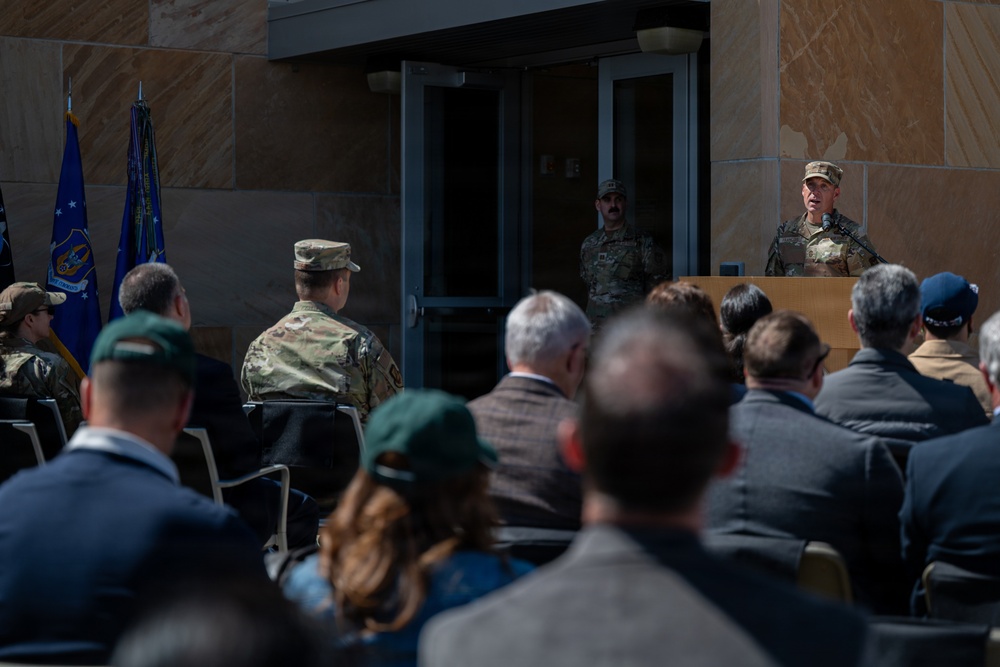
Photo By Tech. Sgt. Marko Salopek | Chief Master Sgt. Joshua Francois, 310th Space Wing command chief, speaks to a crowd...... read more read more
SCHRIEVER SPACE FORCE BASE, Colo.-- The 310th Space Wing honored its founding leaders and buried a time capsule for future generations during a ceremony here April 18, 2026, marking the 84th anniversary of the Doolittle Raid.
During the ceremony, the road leading to wing’s headquarters was renamed from Talon Way to Casserino Way, in honor of Maj. Gen. Frank Casserino, who re-established the unit as a space organization in 1997 and is credited as the father of the 310th Space Wing. Building 26, the 310th headquarters building, was dedicated as the William Bower Building, named for the Doolittle Raider who commanded the 310th Bombardment Group in Italy in 1945, the unit whose lineage today's 310th Space Wing carries. A time capsule was also buried on the grounds, sealed for the Airmen who one day will again serve under the unfurled colors of the 310th.
The ceremony comes as the wing prepares for inactivation as a result of the Space Force Personnel Management Act, signed into law in December 2023. Under the act, space-focused Air Force Reserve personnel have been offered transfers to the U.S. Space Force, and many of the wing's members have accepted assignments within the Space Force or other Air Force Reserve Command units.
Retired Col. Roscoe Griffin, the first full-time member of the 7th Space Operations Squadron under Casserino's command, described the general as a leader who "meant a lot to this unit, more than a lot."
When Casserino took command, the squadron had 30 Airmen. Air Force Reserve Command had little experience with space operations and initially placed the squadron as a communications unit under the 302nd Airlift Wing, which had no space background of its own.
"Frank didn't see that as a problem," Griffin said. "He saw that as, they don't know what we're doing."
From their first meeting in the hallway, Griffin said Casserino made his intentions clear.
"The first thing he says to me is, 'Rock, we're gonna make this thing grow,'" Griffin said.
Casserino also fought to build careers for the Airmen under his command, a critical challenge in a unit where promotions beyond captain were limited by the small number of available positions.
"General Casserino knew he had to get jobs for these people so they can have a career in space," Griffin said. "It was his vision in making this grow that allowed these people and me and others to have a career in space."
Griffin said more than a dozen general officers and numerous chief master sergeants could trace their careers back to Casserino's advocacy during the unit's formative years. He recalled one staff sergeant in particular, LaVon Green, who was told by peers that the space mission would never amount to anything and that she should turn down the assignment. She accepted it anyway, Griffin said, and retired as a chief master sergeant.
Within four years of Casserino taking command, Air Force Reserve space operations had grown into a group. By 2008, it had become a wing. At its peak, the wing numbered approximately 1,500 personnel.
"This is the kind of guy Frank Casserino was," Griffin said. "He was not only visionary, he was a great leader. He was a loving father, and he loved the 310th as well."
The headquarters building of the wing Casserino fought to create now bears the name of a man whose connection to the unit stretches back to its WWII origins.
On April 18, 1942, then 1st Lt. William M. Bower piloted the 12th of 16 B-25 Mitchell medium bombers to take off from the deck of the USS Hornet, striking assigned targets in Yokohama, Japan, before bailing out over China when his aircraft ran out of fuel. Bower returned to the United States two months later and was awarded the Distinguished Flying Cross for his role in the raid.
He continued combat operations in the European and Mediterranean theaters. In July 1945, he took command of the 310th Bombardment Group and led it through the closing months of the war.
The 310th Bombardment Group, flew B-25s throughout the Mediterranean theater, supporting the Allied invasions of Sicily, Salerno and southern France, and earning two Distinguished Unit Citations for its combat service.
Bower remained in the service after the war, transferring to the newly established U.S. Air Force in 1947 and retiring as a colonel in 1966. At the time of his death in January 2011 at age 93, he was the last surviving pilot of the Doolittle Raid.
Chief Master Sgt. Joshua Francois, 310th Space Wing command chief, said the joint dedications reflected something he sees throughout the wing, a professional bloodline that stretches across generations.
"You don't just wake up one day knowing how to execute a complex mission or navigate the demands of a service," Francois said. "Someone has to teach you. Someone has to show you how to lead, how to adapt, and how to uphold the values that define us."
He described Bower and Casserino as men forged from the same steel, despite their service being separated by decades.
"Whether navigating the earliest days of space operations or flying into the unknown during World War II, they shared the same unwavering focus of the mission and the same trust in the people beside them," Francois said. "They set a standard defined by preparation, by precision, and by courage, and we are proud inheritors of that standard."
Francois, whose career has been spent largely in electromagnetic warfare mission sets, described the time capsule as a transmitter broadcasting through time. In the world of radio frequency, he explained, the farther a signal travels, the weaker it becomes, a property called attenuation. The capsule, he said, is meant to keep the 310th's signal clear for future Airmen.
The capsule contains four items, each chosen deliberately: the wing patch, the wing's final guidon, a challenge coin, and the wing's last roster.
The patch, Francois said, has been worn by thousands of Airmen and represents the identity of citizen Airmen who stepped away from civilian life to serve. The guidon stood at the front of formations through every drill weekend, every inspection and every deployment. The coin marks the professional culture of the unit. But the roster, he said, was perhaps the most important item of the four.
"Every name on it represents someone who chose to spend their weekend, their holidays, their late nights serving something bigger than themselves," Francois said. "It tells the story of mentorship, of sacrifice, and quiet dedication."
"Years from now when technology has changed and our uniforms look different, the people who find this will see these names," he said. "They will understand that the success of this wing wasn't built on hardware. It was built on the character of the Airmen on the roster."
Francois also acknowledged the bittersweet nature of the ceremony as the wing prepares for inactivation.
"For some, it may seem like an ending, but for us, it's the silence that follows a mission accomplished," he said. "The quiet satisfaction of knowing we did exactly what we were called to do."
He added that the bond between 310th Airmen would not break simply because the flag is furled, noting that the lessons taught and standards set within the unit would continue through the Airmen its members had mentored.
The ceremony concluded with the Doolittle Raiders toast, a tradition established by the Raiders themselves and observed annually by the 310th Space Wing’s 380th Electromagnetic Warfare Squadron to honor their shared heritage, the members currently deployed and the members no longer present. For this year’s toast, the tradition carries particular weight as it is likely the last during this chapter of the 310th’s history.
As the wing continues its transition toward inactivation, its members carry the values affirmed during the ceremony into new assignments across the Space Force, Air Force Reserve Command and beyond. The time capsule, buried on the grounds of the newly named William Bower Building, awaits the Airmen that once again serve under the colors of the 310th.
| Date Taken: | 04.18.2026 |
| Date Posted: | 04.22.2026 17:51 |
| Story ID: | 563371 |
| Location: | COLORADO SPRINGS, COLORADO, US |
| Web Views: | 349 |
| Downloads: | 0 |

This work, 310th Space Wing honors founding leaders, preserves legacy, by TSgt Marko Salopek, identified by DVIDS, must comply with the restrictions shown on https://www.dvidshub.net/about/copyright.


No keywords found.





