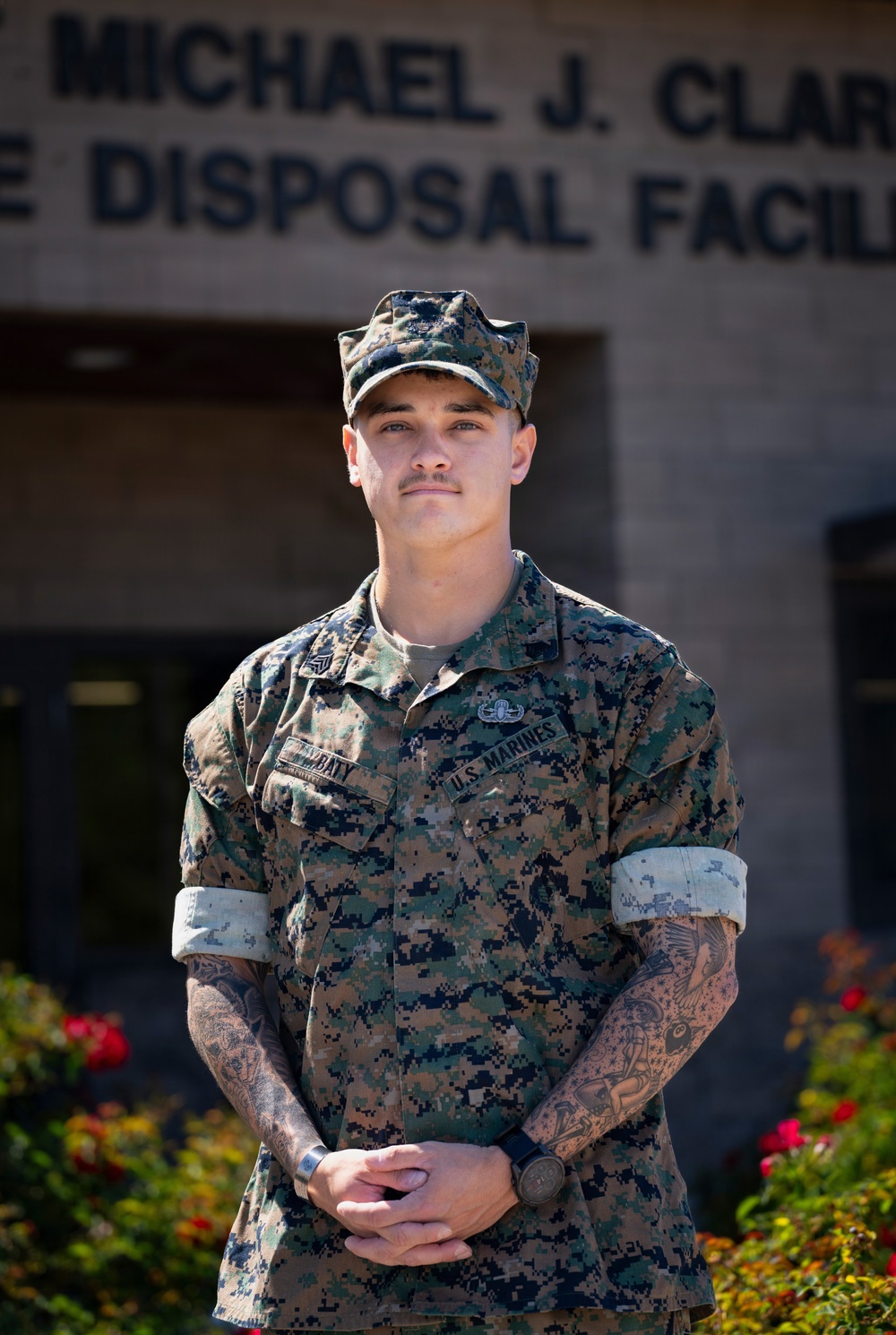
Photo By Sgt. Morgan Burgess | U.S. Marine Corps Sgt. Samuel Baty, an explosive ordnance disposal technician with 7th Engineer Support Battalion, 1st Marine Logistics Group, poses for a photo at Marine Corps Base Camp Pendleton, California, April 8, 2026. Baty, a former water support technician, successfully transitioned into the EOD community to find greater fulfillment while continuing to serve. Baty is a native of Napa, California. (U.S. Marine Corps photo by Sgt. Morgan L. R. Burgess) see less
| View Image Page
MARINE CORPS BASE CAMP PENDLETON, CALIFORNIA, UNITED STATES
From Water Dog to EOD: Sgt. Samuel Baty’s Lateral Move to Mission Success
MARINE CORPS BASE CAMP PENDLETON, Calif. — A well-placed poster featuring explosive ordnance disposal technicians inspired a first-term Marineto laterally move into the field, allowing him to remain in the Marine Corps and allowing him to pursue a unique and challenging mission set while continuing his service in the Corps.
Sgt. Samuel Baty, a native of Napa, California, is an EOD technician with 7th Engineer Support Battalion, 1st Marine Logistics Group. He began his career as a water support technician within the same battalion he serves now. Affectionately known as a “water dog,” Baty found himself in a military occupational field he exceled in but didn’t envision as a long‑term career path.
“The driving point for me was I knew I wanted to stay in the Marine Corps, but I didn’t know much about EOD at the time,” Baty said.
Baty appreciated the appeal of a tight-knit community and a challenging MOS that tested his leadership and mental strength. Unlike the other military branches where EOD is open to entry-level service members, the Marine Corps requires noncommissioned officers to volunteer. The joint-service school at Eglin Air Force Base in Florida trains students from across all military branches. Despite having more time in service than most of his classmates, Baty observed the dynamic of the group was notably mature.
Leadership and responsibility are central themes in EOD technician training, where enlisted personnel from across the joint force are held to rigorous standards. During the 10-month course, Baty and his classmates endured long hours, intense mental and physical challenges, and exceptionally high expectations.
Recalling his training days, Baty said, “Up at 4 a.m., in the classroom at 5:30 a.m. Study all day. Gym. Home. Sleep. Repeat, for 10 months. They’ll close the doors on you if you’re late. Everything counts.”
The training covers demolition, tools and methods, core skills, ground and air ordnance, improvised explosive devices and chemical and biological ordnance, along with the associated techniques and methods for each area.
EOD technicians are responsible for handling a wide range of hazardous threats, including chemical, biological, nuclear, conventional ordnance and improvised explosive devices. Baty gained practical experience while on temporary additional duty with the Marine Corps Base Camp Pendleton EOD team. This assignment involved collaborating to train and teach or learn from civilian law enforcement agencies such as the Naval Criminal Investigative Service and local sheriff's departments. One of Baty’s favorite parts of his job is educating partner agencies on how to safely recognize various hazards.
Master Sgt. Travis Unwin, an EOD technician and Baty’s section chief, expressed his trust and confidence in him: “Some first-term EOD technicians become humbled by the experience of more senior EOD technicians as they navigate this new job. Sgt. Baty is a quick learner and eager to gain that experience for himself. He is [quickly] adapting to his surroundings and shouldering responsibilities within the EOD section.”
EOD units often work in teams of three Marines: one team leader, normally a staff sergeant or above and two team members, typically NCOs. As a team member, Baty’s job is to support the team leader in every aspect of a mission.
“My job is to take stress off the team leader,” Baty said. “They’re the one going downrange. I want them focused on that one problem, not 10 other things.”
Daily life includes scenario‑based training, robot operations, studying ordnance publications and preparing for upcoming ranges. One unique, Marine‑only capability is exploitation; the controlled disassembly of ordnance to remove explosive hazards. “No other branch is allowed to do exploitation,” Baty said. “It’s a unique thing we get to do.”
The EOD community is small, and screening is strict. Marines must achieve a first‑class score on the physical fitness test and combat fitness test. They must also pass a bomb suit test, which involves donning an 80-pound bomb suit and perform rigorous physical training, as well as a candidate interview and written tests.
Baty explained that the bomb suit test is designed to expose Marines to the heat, stress and claustrophobic conditions they may face in critical moments.
According to Baty, evaluators are constantly assessing whether a Marine possesses the necessary maturity for the role. This assessment is often simplified to two fundamental questions: “‘Do I want to work with this Marine? Could this be my team member someday?’"
With sergeant being the lowest rank in the MOS, EOD maintains a professional environment built on trust and competence.
“It’s big‑boy rules,” he said. “Take care of your responsibilities. Stay fit. Handle your business.”

 Subscribe






