
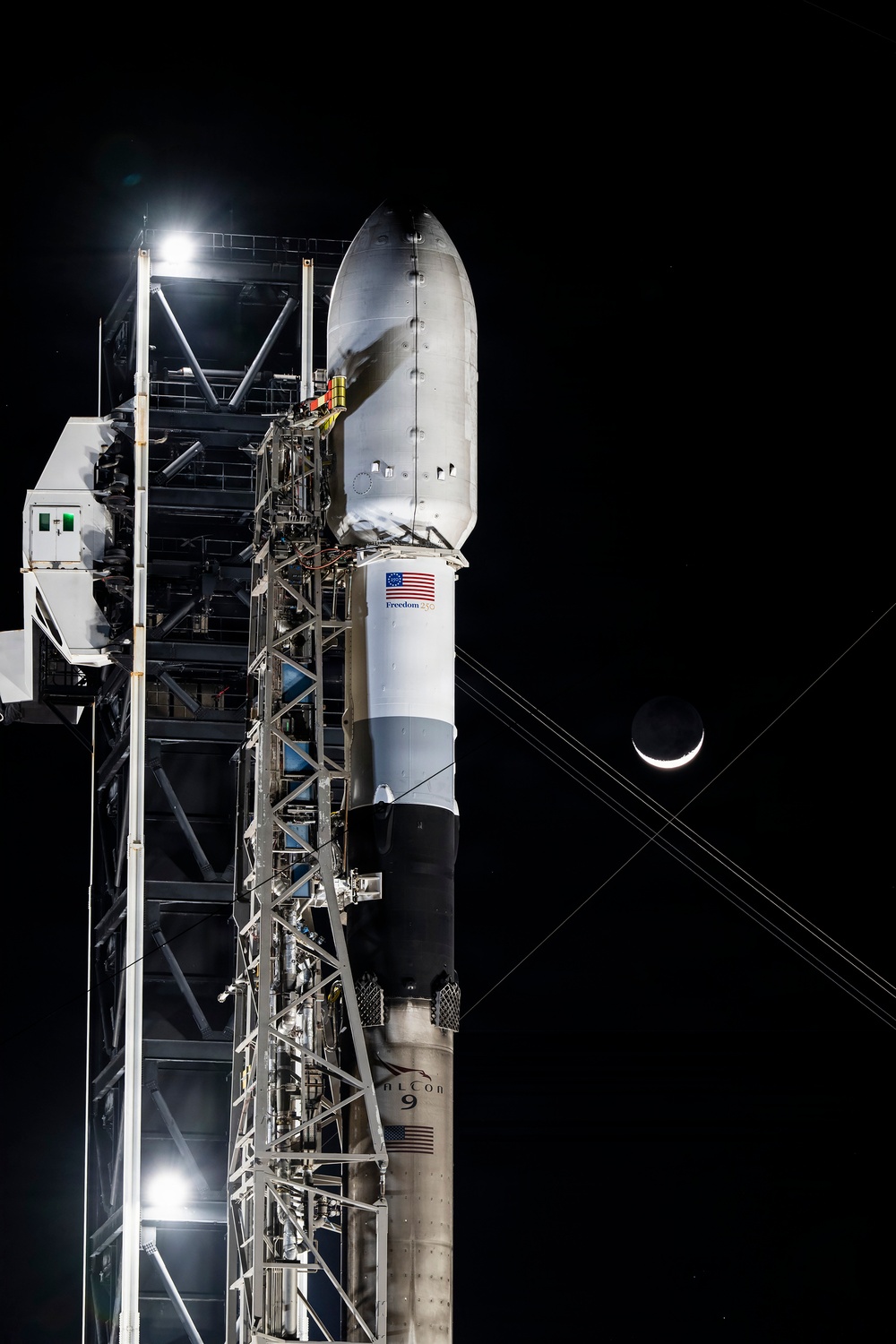
Photo By Maj. Brittany Curry | A SpaceX Falcon 9 rocket stands vertical ahead of the National Security Space Launch...... read more read more
 Subscribe
Summary: The U.S. Space Force successfully launched the National Security Space Launch (NSSL) Global Positioning System (GPS) III-8 (Space Vehicle-10, SV-10) mission, delivering the final GPS III satellite to orbit and completing the service’s strongest, most resilient constellation to date. SV-10 includes the integration of a development payload for a crosslink demonstration, new space-qualified atomic clock, a Laser Retroreflector Array (LRA), and first-use of a 3D-printed Omni Antenna. The completion of this mission demonstrated another instance of the NSSL program’s flexibilities for responsive and reliable launch, executing a change in under seven weeks following a pivot in the launch service provider.
EL SEGUNDO, Calif. & COLORADO SPRINGS, Colo. – The U.S. Space Force’s (USSF) Space Systems Command (SSC) and Combat Forces Command (CFC) successfully delivered the Global Positioning System (GPS) III-8 (Space Vehicle-10, SV-10) mission into orbit as part of the National Security Space Launch (NSSL) program. SpaceX’s Falcon 9 rocket launched the mission Apr. 21 at 2:53 a.m. EDT (11:53 p.m. PDT Apr. 20) from Space Launch Complex (SLC)-40 at Cape Canaveral Space Force Station, Fla.
“This launch is another example of the NSSL program’s flexibility to carry out responsive and reliable launch for our mission partners to deliver critical capabilities on orbit, when and where it’s needed,” said USSF Col. Ryan Hiserote, SSC System Delta 80 (SYD 80) commander, NSSL program manager, and GPS III-8 mission director. “The collective efforts across the Space Force, and our close collaboration with SpaceX, allowed us to adjust the manifest in under seven weeks, a remarkable achievement compared to traditional timelines.”
SYD 80’s ability to execute on a rapid timeline builds off previous missions dating back to December 2024 with the Rapid Response Trailblazer (RRT)-1 launch of the GPS III-10 (SV-07) mission, which was followed by two additional accelerated launches of the GPS III-7 (SV-08) mission in May 2025 and the GPS III-9 (SV-09) mission in January of this year. Each previous launch showcased an ability to further reduce the timescale. The flexibility was further enabled by Lockheed Martin’s modular interface design for GPS III, allowing for payload integration and compatibility among multiple providers.
“The government acquisition strategy and industry collaboration that drove a common integration standard for GPS III satellites has proven time and again to be a strategic forethought in enhancing our launch flexibility,” Hiserote said. “The Space Access and SYD 80 team have an unwavering commitment to deliver capabilities for the warfighter. As seen in this rapid pivot for the GPS III-8 mission, the decisions of our acquisition’s experts expand the avenues we can leverage for launch and directly enhance the Space Force’s ability to maintain space superiority for the Nation.”
The successful delivery of GPS III-8 (SV-10) completes the strongest and most resilient constellation to date, marking 32 satellites in the active constellation, with added redundancy and resiliency including additional vehicles on orbit. SV-10 provides the current constellation an additional satellite equipped with M-code technology, which provides GPS capabilities to the warfighter that are three-times more accurate and eight times more resistant to jamming than the previous constellation.
SV-10 is not only the final GPS III satellite but stands as the most innovative space vehicle in program history as the result of integrating multiple demonstrations.
“Through the partnership and integration of Space Force and industry teams, this launch delivers a lot for the Space Force and warfighter, bringing together an important operational capability in GPS III SV-10 with a developmental payload that’s paving a way to the future using a novel approach,” said USSF Col. Stephen A. Hobbs, CFC Mission Delta 31 (MD31) commander. “The team used lead-time ahead of launch to strategically integrate multiple demonstrations and leverage the ability to continue innovation of our future GPS constellations.”
The development payload includes:
“Among the various demonstrations, the testing of crosslink laser communications on a GPS satellite will be a key element because it allows us to evaluate next-generation capabilities that can enhance the resilience and responsiveness of our space systems,” Hobbs said. “These technologies have the potential to move data faster, more securely, and with greater flexibility, strengthening our ability to deliver the critical positioning, navigation, and timing services for military and civil uses worldwide.”
With the completion of this constellation, the USSF is now focused on future improvements embedded in the next-generation GPS IIIF satellites. GPS IIIF will further improve anti-jam and anti-spoofing capabilities for U.S. and allied military by adding an additional capability known as Regional Military Protection that provides M-Code GPS signals to qualified military users, providing over 60 times more anti-jam capabilities than legacy space vehicles.
About SSC Space Systems Command is the U.S. Space Force field command responsible for acquiring, developing, and delivering resilient capabilities to outpace emerging threats and protect our Nation’s strategic advantage in, from, and to space. SSC manages a $15.6 billion annual space acquisition budget for the Department of Defense, working with joint forces, industry partners, government agencies, academia, and allied nations. For more information, visit ssc.spaceforce.mil and follow @USSF-SSC on LinkedIn.
About SYD 80 SYD 80 executes the U.S. Space Force's core function of Space Access, performing space lift and range control missions in close partnership with the 30th and 45th Space Launch Deltas. Additionally, the delta develops resilient and ready launch and test infrastructure to expand U.S. economic, technological, and scientific leadership. Furthermore, SYD 80 delivers servicing, mobility, and logistics capabilities that operate in, from, and to the space domain.
About CFC U.S. Space Force Combat Forces Command, one of three Field Commands, is the U.S. Space Force’s Service Force Provider. CFC is focused on generating and presenting combat-ready forces capable of achieving space superiority; fortifying mission resiliency and grit through self, family, and installation readiness; and advocating for combat-ready spacepower from the future force to the fielded force. CFC encompasses eight distinct, but integrated mission and space deltas and three space base deltas focused on Space Domain Awareness; Space Electromagnetic Warfare; Missile Warning and Tracking; Cyberspace Warfare; Intelligence, Surveillance, Reconnaissance, and Targeting; Satellite Communications; Orbital Warfare; and Navigational Warfare.
About Mission Delta 31 MD 31’s mission is to provide, operate, and sustain Satellite Control & Navigation Warfare to protect our Nation’s interests. MD 31 is the world’s premiere provider of positioning, navigation, timing, and satellite control…for all users, in all places, at all times.
Media representatives can submit questions for response regarding SSC and AATS by sending an e-mail tomailto:sscpa.media@spaceforce.mil
Media representatives can submit questions for response regarding CFC and MD31 by sending an e-mail to mailto:spoc.pa.media@spaceforce.mil
| Date Taken: | 04.21.2026 |
| Date Posted: | 04.21.2026 07:46 |
| Story ID: | 563203 |
| Location: | US |
| Web Views: | 734 |
| Downloads: | 0 |

This work, U.S. Space Force delivers final GPS III to orbit, advancing its most resilient constellation for military, civil capabilities, by Maj. Brittany Curry and James Spellman, identified by DVIDS, must comply with the restrictions shown on https://www.dvidshub.net/about/copyright.


No keywords found.




