
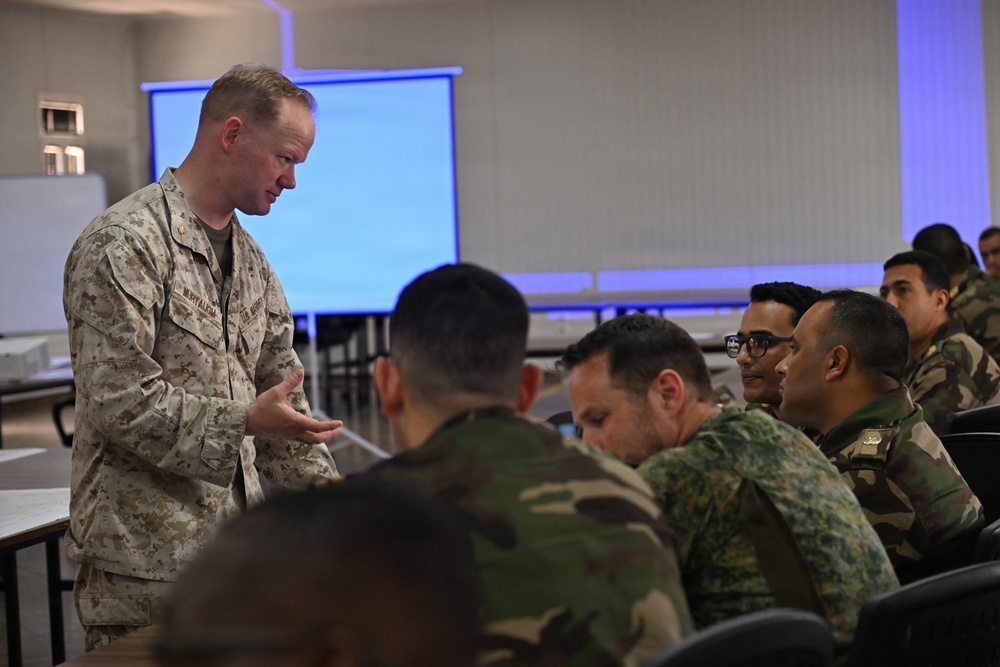
Photo By Airman 1st Class Alexandra Dale | U.S. Marine Corps Maj. Keefe Murtaugh, African Lion 26 academics coordinator and team...... read more read more
 Subscribe
AGADIR, Morocco — More than 400 multinational service members are gathering to participate in the academic portion of African Lion 2026 at Southern Zone Headquarters, Agadir, Morocco, April 20 to May 1.
The academic phase of the exercise features 22 intensive courses. These classes prepare multinational service members to use unmanned aerial systems, cyberspace defenses and satellite operations before they head into simulated combat.
“The academics portion of the exercise serves as a critical foundation for follow-on training and operations,” said U.S. Marine Maj. Keefe Murtaugh, AL26 academics coordinator and team two operations officer with Marine Corps Advisor Company Alpha, Force Headquarters Group, U.S. Marine Forces Reserve. “The academic program is designed to enhance technical expertise, accelerate decision-making and improve operational effectiveness across all domains, three elements critical to shortening the decision cycle in modern conflict.”
Courses range from entry-level instruction to advanced operational planning, ensuring leaders at every echelon are equipped to contribute to mission success. Training on unmanned aerial systems spans both tactical execution and operational integration.
“The operator course is meant to instruct service members on how to conduct UAS operations, basic flight instruction,” Murtaugh said. “The planner course is really intended for noncommissioned officers, senior NCOs and officers to think about how to employ UAS from a day-to-day perspective.”
Advanced courses are expanding into emerging domains, including space, electromagnetic warfare and cyberspace, areas critical to maintaining an advantage in increasingly contested environments.
“This year features an advanced [electronic warfare] and space course,” Murtaugh said. “The students that went through the basic course here last year are determining how to integrate with satellite operations in a bigger way, which is something that we haven't done before.” The 10-day cyberspace operations course further underscores the exercise’s focus on innovation and investment in modern capabilities.
U.S. Army 1st Lt. Mason Elizondo, an AL26 cyberspace operations instructor assigned to the 183rd Cyber Protection Team, U.S. Army Reserve Cyber Protection Brigade, is directly contributing to that effort by training partner forces to defend critical cyber infrastructure.
“Today we are instructing the Moroccan partner force on the introduction to cybersecurity… how to posture themselves effectively for threat hunting and cyber and best cybersecurity practices,” Elizondo said.
The training is designed to empower partner forces with the tools and knowledge needed to operate independently and defend their own networks, an essential component of burden-sharing and long-term regional stability.
“Our goal is to instruct partner forces and get them into a good position so that they can conduct their missions effectively and protect their cyber key terrain,” Elizondo said. “We need to teach them and choreograph with them to make sure that they have their own priorities set straight so they can do their own threat hunts.”
Elizondo added that the instruction focuses on detecting and countering adversary activity across multiple platforms.
“I will be teaching the students how to hunt and detect persistence on a network from figuring out how attackers get into the network and how they stay on the network to anything from a Windows system to a Linux system or a cloud environment,” he said.
The multinational environment also enables a two-way exchange of knowledge, reinforcing innovation and adaptability across the force.
“They are incredibly proficient and incredibly knowledgeable,” Elizondo said. “We’re not just imparting knowledge on them; we’re also getting knowledge from them. We get to interact with all different types of partner forces.”
For Murtaugh, this collaborative approach is central to building interoperable forces capable of responding to shared challenges.
“We partner with foreign forces and help validate their doctrine, work through the planning process and make sure we can maximize interoperability,” he said.
The academic phase plays a vital role in preparing participants for subsequent exercise events, ensuring forces can effectively apply their training during planning and execution phases.
“The academics portion is critical because it's helping a lot of these students refresh, or be introduced to some of the material that they're going to apply during either the planning or execution for command field exercises,” Murtaugh said.
U.S. Army 1st Sgt. Travis Herman, Intelligence and Sustainment Company first sergeant, Headquarters and Headquarters Battalion, U.S. Army Southern European Task Force, Africa (SETAF-AF), said the experience reinforces shared goals among partner nations.
“This is my first time teaching in Africa,” Herman said. “I'm most excited about getting to know the Royal Moroccan Armed Forces, their culture and getting to see how they run things.”
Herman, who teaches the noncommissioned officer development course, said the training enhances readiness for both U.S. and partner forces.
“It is helping increase readiness with both them and us because it refreshes me on some foundations that I haven't touched on in a couple years,” he said.
Through engagement with partner forces, Herman emphasized the common ground that underpins multinational cooperation.
“From training alongside our partners and our allies, I just continue to learn that we are more similar than we are different,” he said. “They want the same things that we want for our Soldiers, readiness.”
By combining academic instruction with multinational collaboration, AL26 strengthens deterrence, validates innovative approaches and empowers partner nations to build sustainable, independent capabilities, ensuring a more ready, capable and interoperable force for the future.
| Date Taken: | 12.31.1969 |
| Date Posted: | 04.20.2026 12:18 |
| Story ID: | 563106 |
| Location: | AGADIR, MA |
| Web Views: | 232 |
| Downloads: | 0 |

This work, African Lion 2026 academics builds readiness, drives innovation, by SSG Raquel Birk, identified by DVIDS, must comply with the restrictions shown on https://www.dvidshub.net/about/copyright.


No keywords found.




