
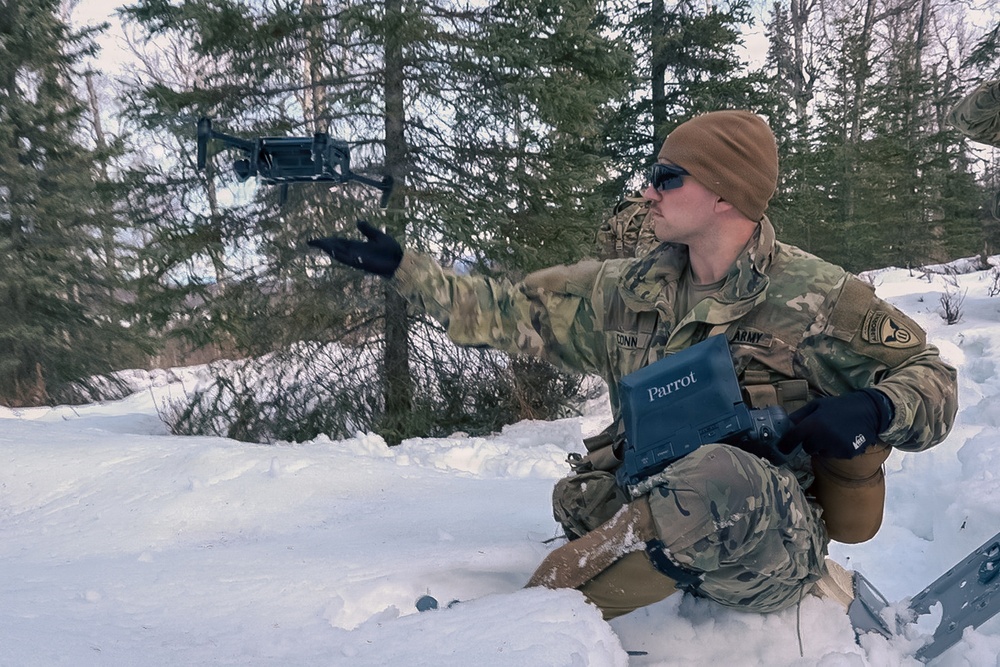
Photo By Sgt. Brandon Vasquez | A U.S. Army soldier assigned to the Multi-Functional Reconnaissance Company, 2nd...... read more read more
 Subscribe
JOINT BASE ELMENDORF-RICHARDSON, Alaska – U.S. Army Soldiers assigned to the Multi-Functional Reconnaissance Company, 2nd Infantry Brigade Combat Team (Airborne), 11th Airborne Division, conducted Operation Arctic Tech, a weeklong training exercise at Joint Base Elmendorf-Richardson, Alaska, from April 7 to April 10.
The exercise focused on familiarizing platoons with unmanned aircraft systems, electronic warfare and counter-unmanned aircraft systems during reconnaissance operations in a cold-weather environment.
“Establishing this company presents a unique opportunity to build cohesive, multi-functional teams that operate in unison," said Capt. Patrick Robinson, Commander of the 2/11 MFRC. “By integrating capabilities such as electromagnetic warfare, aerial surveillance, and reconnaissance scouts within a unified kill chain, we are able to deliver comprehensive and effective support to the brigade’s mission.”
The training began with an air assault from Bryant Army Airfield, supported by Alaska National Guard aviators flying UH-60 Black Hawk helicopters. Soldiers were inserted into Landing Zone Warbler before moving on snowshoes through dense, snow-covered terrain toward multiple named areas of interest to identify potential targets.
During the operation, reconnaissance elements combined traditional observation techniques with modern systems, including Parrot first-person view drones and multi-domain assets such as the Versatile Radio Observation and Direction system and the VROD Modular Adaptive Transmit system. These tools enabled soldiers to locate critical equipment, identify targets and apply electronic warfare effects.
To enhance safety and mobility, squads also employed handheld counter-unmanned aircraft systems, including the Drone Buster Block V4, to detect, track and disrupt enemy drones. Used alongside reconnaissance drones and electronic warfare systems, the equipment created a layered approach that allowed units to maneuver more freely while limiting adversary drone activity.
Sgt. Jacob Connolly, a drone instructor, operated a Parrot drone to gain an overhead view of the training area. Within 30 minutes of deployment, he identified targets and obtained their coordinates.
After grid coordinates were confirmed by a reconnaissance element observing the target area, the information was transmitted through communications channels to a strike team First-person view drones were then used in a simulated strike on a dummy High Mobility Artillery Rocket System, demonstrating how units can rapidly transition from reconnaissance to engagement.
“By leveraging advanced technology to lead our efforts and confirming findings through our recce scouts, we are able to more effectively identify and target high-priority threats,” Robinson said.
The training highlighted the expanding responsibilities of soldiers within the unit. Reconnaissance personnel not only observe the battlefield, but also operate and maintain unmanned systems and electronic warfare equipment.
“At the MFRC, we developed a multi-functional team concept where we have directly embedded our UAS and EW operators in with the reconnaissance aspect, they cross-train every single day,” said 1st Sgt. Sean Jolin, senior enlisted advisor for the company. “That's been a focus. Getting these guys to train together as a cohesive unit, so everyone knows how to do each other's roles across all domains.”
Leaders emphasized the importance of integrating these capabilities into planning and execution. Officers and noncommissioned officers worked closely with subject matter experts across multiple military occupational specialties to align technology with the commander’s intent and key information requirements.
“We have a specific role in the MFRC,” said Pfc. Elliott Watson, an electronic warfare operator. “If we can identify communications equipment, radar systems or confirm enemy forces in an area, it can push the brigade’s mission forward. Through spectrum analysis, we can detect enemy activity based on their transmissions.”
The integration of reconnaissance, unmanned systems and electronic warfare improves the unit’s ability to collect, confirm and share information quickly, enhancing targeting and reducing reliance on external reconnaissance assets.
“The way we’re embedding drones and spectrum analysis systems into reconnaissance teams is a force multiplier,” said 1st Lt. Roman Wright, a platoon leader. “It allows us to rely on our specialists to employ their systems effectively and enables better decision-making at all levels.”
The training reflects the Army’s broader focus on operating in a multidomain environment to counter emerging threats under extreme conditions. Conditions that have also been observed during exercises such as Joint Pacific Multinational Readiness Center 26-02, where the reconnaissance company identified key enemy positions, including a tactical operations center, early in the exercise.
“We are transforming the task organization of the 2nd IBCT (Airborne) by integrating previously separate electronic warfare, small unmanned aerial systems and reconnaissance elements into combined teams,” Robinson said. “This approach has produced significant results across multiple training events.”
The 11th Airborne Division continues to refine how it employs these integrated capabilities and shapes how the brigade will utilize them in future exercises and operations. As these systems and methods develop, the unit is building a more adaptive and responsive force.
“Two years down the road, five years down the road, getting the right equipment and putting these new and emerging systems in the hands of the users. Once we get all the things that we need to be successful, this unit is going to change how modern warfare is fought,” said 1st Sgt. Jolin.
| Date Taken: | 04.17.2026 |
| Date Posted: | 04.17.2026 16:54 |
| Story ID: | 562993 |
| Location: | ALASKA, US |
| Web Views: | 388 |
| Downloads: | 1 |

This work, 11th Airborne Division MFRC Integrates UAS, C-UAS and EW Capabilities to Expand Reconnaissance in Arctic Operations, by SGT Brandon Vasquez, identified by DVIDS, must comply with the restrictions shown on https://www.dvidshub.net/about/copyright.


No keywords found.




