Demand Increases for Consults on Chemical Warfare Defense
Photo By Anna Applegate |
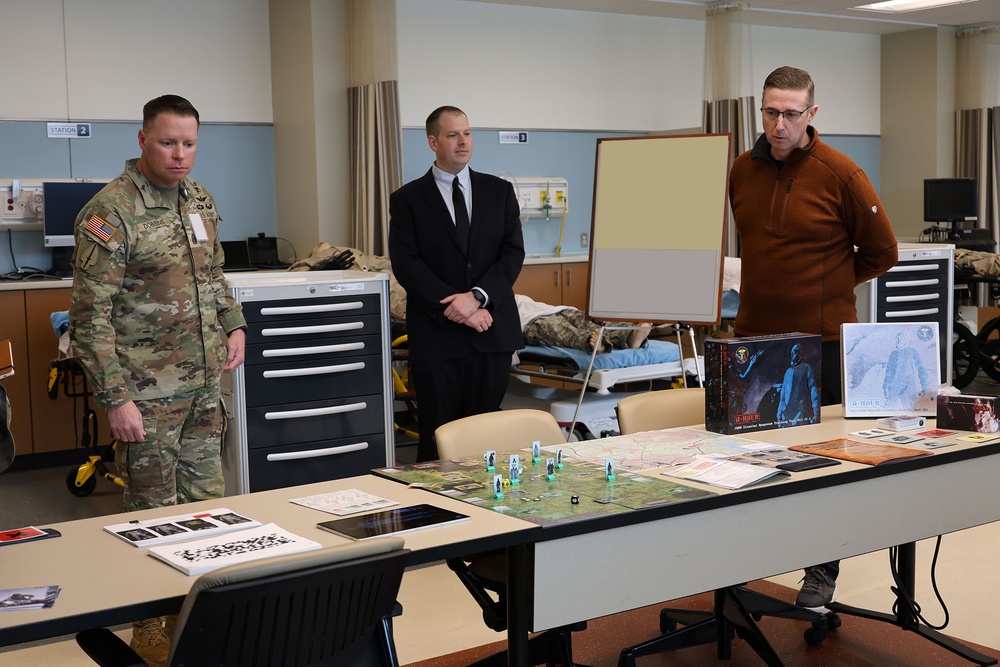
In his role as Chief of Consultation and faculty at USAMRICD, Dr. Nogee (center)......read moreread more
Photo By Anna Applegate | In his role as Chief of Consultation and faculty at USAMRICD, Dr. Nogee (center) presents the simulation and other education tools used by the institute to prepare joint force and allied partners to medically counter the use of chemical warfare agents. (photo credit: U.S. Army Medical Research Institute of Chemical Defense) see less
| View Image Page
Demand Increases for Consults on Chemical Warfare Defense
As adversaries continue to pursue the use of chemical weapons, calls to the Defense Health Agency Research & Development - Medical Research and Development Command’s Medical Research Institute of Chemical Defense for assistance with chemical defense have tripled. The weaponization of chemical agents—designed to burn, poison, or attack nervous and respiratory systems—has escalated in recent years, driving a significant increase in requests for expert guidance.
This heightened demand for consultation is managed by Dr. Daniel P. Nogee, Chief of Consultation at the Chemical Casualty Care Division of the USAMRICD. Over the past three years, requests for CCCD consultations have risen from 61 to 197, reflecting the growing need for specialized expertise in chemical defense.
“History tells us that when some country or state believes they can use chemicals to achieve battlefield objectives, they’ll use it,” Nogee said. “Today, chemical defense has a dual purpose. It protects the victims, but it also changes the risk calculus of our adversaries, who may be deterred from attacking if they believe it won’t succeed.”
The CCCD plays a critical role in addressing the complex challenges posed by chemical weapon exposure. Its work encompasses not only the initial diagnosis and immediate care of affected casualties, but also the development of effective decontamination procedures and safe methods for the storage and disposal of hazardous chemicals. The division is actively engaged in researching techniques to degrade volatile compounds, thereby reducing the risks associated with lingering contamination. In addition, the CCCD is committed to advancing long-term patient care strategies for those suffering from the effects of chemical agents, while also providing innovative training tools to better prepare medical personnel for real-world chemical emergencies.
Accidental exposures to chemical agents have also prompted calls for assistance. CCCD experts were called upon for advice when degraded chemical-laden munitions were unearthed during construction at American University in Washington, D.C. The division’s expertise is frequently sought beyond military-related exposures, as demonstrated during the cleanup following the 2023 train derailment in East Palestine, Ohio.
Nogee, an emergency room physician by training, joined the CCCD in 2022, filling a void left by the departure of former Chief of Consultation Dr. James Madsen. Upon his arrival, Nogee quickly reestablished key contacts and renewed demand for CCCD’s services. “Doing good work begets more work,” Nogee said. “Our customers have been happy with the information we provide and the connections we develop. They tend to reach out for more questions in the future or refer others once they recognize our expertise.”
Global partners also look to CCCD for its unique expertise. In September 2025, Dr. Nogee represented the division at the NATO Chemical, Biological, Radiological, and Nuclear Medical Symposium in Spiez, Switzerland, where 80 U.S. and allied NATO physicians learned about ’s Advanced CBRN Pharmacy Course. The CCCD continues to collaborate with medical personnel from partner nations, sharing best practices and the latest advancements in chemical casualty care.
CCCD has also identified alternatives to out-of-stock antidotes. Recently, when the Global Field Medical Laboratory at Aberdeen sought a countermeasure for the blistering agent Lewisite that was no longer in production, Dr. Nogee and his team identified effective alternatives to ensure continued readiness.
“The best antidote in the world is useless if the only people who know about it are the scientists who developed it,” Nogee explained. “My role involves teaching people to use novel antidotes, but also to improvise—to use things they already know about to counter chemical agents in ways they haven’t thought of before.”
Nogee emphasized that he works alongside scientists from USAMRICD with a wide range of expertise in various aspects of chemical defense: specialists in individual chemical agents, field instructors on patient decontamination, occupational medicine physicians who address troops’ return-to-duty circumstances, and anesthetists for questions on sedation and airway management. “We have some of the best scientists in the world right here,” Nogee said. “When I have a question about a chemical agent, I’ll walk down the hall and get input from a scientist who has done more research than anyone in the world.”
USAMRICD’s work supports DHA R&D-MRDC’s promise to deliver medical capabilities to warfighters with integration and innovation, ensuring that U.S. forces can outpace enemies and defeat all threats.
“I’m encouraged that demand is so high across our military for knowledge and preparation for chemical defenses,” Nogee said. “Our mission is focused on sharing information to reduce enemy lethality. If we teach people how to prevent casualties and be prepared with good medical management, then our adversaries are less inclined to use chemical warfare agents.”