
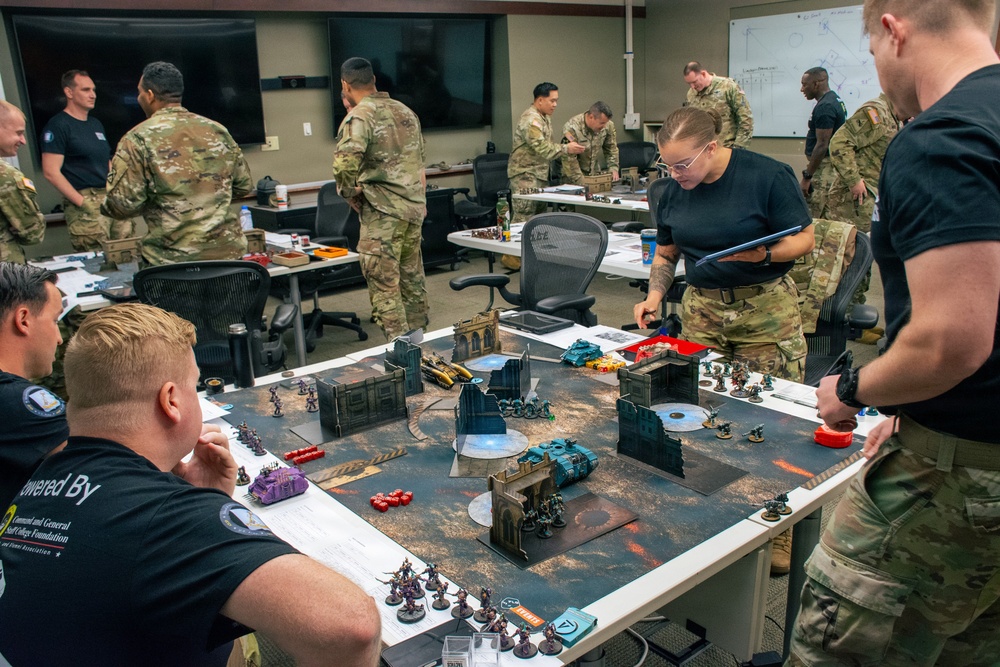
Photo By Jessica Brushwood | School of Advanced Military Studies students conduct an experiment with a tabletop...... read more read more
FORT LEAVENWORTH\, Kansas |
Throughout their program, School of Advanced Military Studies students are challenged to become creative and critical thinkers, prepared for a demanding future operating environment shaped by evolving technology and national security threats.
The final academic course, Future Operational Environment, uses cutting-edge lessons and practicums to ensure graduates are future-literate so they can confidently analyze future military scenarios and address emerging challenges.
Students reinforced these skills using a wargaming methodology developed by Stephen Box, a British educator, strategist, social media influencer, and owner of a coaching academy between March 30 and April 2, 2026.
“I cannot imagine a time in recent history where the skills associated with future thinking are more needed than now,” stated Matt Yandura, SAMS Assistant Professor and course author.
Box’s IDEA framework for decision-making, developed over years of tabletop wargaming and coaching, closely mirrors military decision-making.
“The long-term benefit of this visit is that our students and faculty now have access to an additional framework that has been tested as part of an exploratory practicum to enable more lethal military formations,” Yandura said.
The IDEA framework involves gathering the right information under time constraints (I), translating information into decisive action while identifying priorities and trade-offs (D), execution that involves resource allocation, composure, managing variance (E); and assessing how things went with the option to pivot (A).
After receiving instruction from Box, the group explored the utility of the futures-based concept planning method alongside Army tools like Army design methodology, the rapid decision-making process, joint planning and execution frameworks, and the principles of war.
Box stated his goal was to help students have fun while being creative and gaining a tool to make faster decisions. “To encourage failure in a safe environment should be encouraged because fear of failure can hold you back from making decisions but understanding that failure isn’t always a bad thing,” Box said.
Learning opportunities like this introduce new concepts, methods, and frameworks to keep the curriculum relevant.
“I saw students take away new ways to think about problems under extreme time constraints; assess tradeoffs between actions and outcomes, and thus make decisions that were more rapid, yet still well-informed,” Eric Price, Associate Professor, SAMS, said “Mr. Box talked about maintaining composure—something hard to do when you are stressed and facing the unfamiliar—and the students demonstrated greater ability to do so using his methods.”.
Maj. Carlo Vician, a U.S. Air Force intelligence officer, said the experience of learning and playing the wargame exceeded his expectations, citing the fun he had while learning methods to add to his tactical and operational planning.
“I was very surprised at the speed inwhich Stephen goes through his IDEA methodology and the breadth of information he rapidly ingests and acts on. My biggest takeaway will be purposefully incorporating Stephen's focus on ‘resource-trade analysis,” Vician said.
The resource trade analysis includes determining consequences to an action and what the trade-offs are such as time and space or resources for resources.
As a proponent of sportsmanship and fair play, Box said he was inspired by his experience with the students. In addition to the pace at which they learned, he noted their interactions with one another and their collective empathetic, humble, and supportive characters.
“I learned different techniques and how to see things. I have also learned how great having a high peer group accelerates everybody. How they all push each other day in and day out to be the absolute very best. How they listen to each other’s opinions and don’t put each other down because they are all learning from each other all the time,” Box said.
He shared that he also found it “amazing that even the skeptics seemed to enjoy the experience and changed their opinion”, as they began putting the method into practice against a real-world scenario.
“For them to come back and say they recognized the merit in the method meant everything,” Box said.
Yandura also expressed optimism of the long-term benefits and the potential for future visits with Box.
“The response from students was overwhelmingly positive. They were excited to see how Box’s wargame planning framework integrates, extends, and enhances existing U.S. military planning frameworks in novel ways,”he said.
In addition to the wargaming exercises, Box conducted a resiliency session with students that included painting the game pieces. He also spoke to the CGSC Foundation, the non-profit that funded his visit, sharing insight with applicability to professionals in various industries.
You can read more about the SAMS’ purpose to educate skilled practitioners of Operational Art and multi-domain warfighters who can lead, fight, and win in any environment in https://smallwarsjournal.com/2026/01/23/the-school-of-advanced-military-studies/ of the CGSC Partnership with the Small Wars Journal.
| Date Taken: | 04.10.2026 |
| Date Posted: | 04.10.2026 14:29 |
| Story ID: | 562468 |
| Location: | FORT LEAVENWORTH, KANSAS, US |
| Web Views: | 126 |
| Downloads: | 0 |

This work, Students at the School of Advanced Military Studies enhance futures thinking, operational, tactical skills alongside successful wargame coach, by Jessica Brushwood, identified by DVIDS, must comply with the restrictions shown on https://www.dvidshub.net/about/copyright.


No keywords found.





