
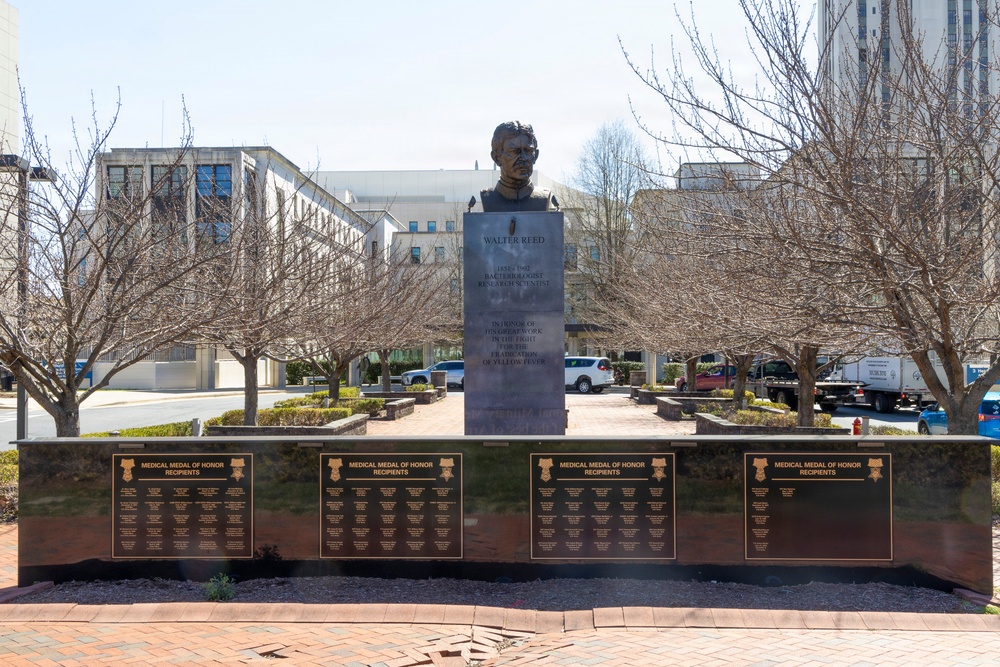
Photo By Christopher Smith | The Medical Medal of Honor wall at Walter Reed National Military Medical Center sits...... read more read more
 Subscribe
By Chris Smith Walter Reed Hospital Communications
Walter Reed National Military Medical Center (WRNMMC) salutes its heroes and their families every day by providing them with presidential care but each year, on March 25, a special group of heroes is recognized – those who have earned the nation’s highest military decoration, the Medal of Honor (MoH).
Walter Reed has had the honor and privilege of caring for MoH recipients over the years, and the hospital takes special pride in honoring them and others who have earned the decorations with special tributes at the medical center.
On the second floor of Building 10 (Eagle Zone), outside Clark Auditorium, the Navy MoH wall displays 22 framed pictures of Naval MoH recipients, as well as numerous images of heroism and inspirational messages captured over the years. Outside Building 19 (America Zone), near the bust of the medical center’s namesake, U.S. Army Maj. Walter Reed, is a set of four black marble walls etched in gold with the names of medical MoH recipients.
There are, in fact, three Medals of Honor, one for the Army, Navy and Air Force. Marines and Coast Guardsmen receive the Navy’s MOH like all service members “who have distinguished themselves through acts of bravery and valor.” Each branch’s medal is distinct and stylized to specifically represent the nature of the military branch they are designed for, and the medals have gone through several changes over the years.
In 1861, as the Civil War began to grow in scale and scope, Secretary of the Navy Gideon Wells authorized the medal’s creation, despite resistance based on the idea that awarding medals for valor was an archaic tradition from the monarchies of Europe America had left behind. Since its inception 3,552 medals have been earned, a significant portion during the Civil War. In 1917, however, during a period referred to as the Purge, 911 of the awarded medals were rescinded for a variety of reasons.
The first name on the Wall of Honor outside Building 19 at Walter Reed is that of Dr. Mary Edwards Walker, one of only eight civilians to receive the MoH since its inception. Born in 1832 to parents that owned a farm outside Oswego, New York, she grew up working on the farm alongside her brother and four sisters. Practicality led the girls to wear men’s clothing while working, and this style choice followed Walker throughout her life. While she initially pursued teaching as a career, her real passion was for medicine, and Walker enrolled at Syracuse Medical College in 1853. Following her graduation in 1855, she was the lone woman in her class and only the second woman to become a doctor in the U.S. She married (wearing a man’s suit during the ceremony) and she and her husband opened a medical practice, which ultimately failed.
At the beginning of the Civil War, after separating from her husband, Walker attempted to enlist in the Union Army. She was declined, but that didn’t stop her, and she volunteered her services, initially as a nurse, and then later as a field surgeon. In that capacity, she was at the Battles of Bull Run, Fredericksburg, Chickamauga and Atlanta, among others, treating her wounded fellow soldiers. During her time in service, Walker wore a man’s uniform that she modified herself and tended to carry two pistols. She would often cross the lines to provide treatment for wounded civilians. It was during one of these trips she was captured and held as a Union spy, ultimately being sent to Castle Thunder prison in Richmond. She was later traded in a prisoner exchange for a Confederate major, a point she was always proud to note, as she was only technically a volunteer at the time.
Walker underwent all these experiences as a volunteer, but in October 1864 she was finally officially appointed as an acting assistant surgeon to the Ohio 52nd Infantry. She was discharged from the Army in June 1865, at the end of the Civil War. She went on to become a major figure in the Women’s Suffragette Movement, fighting to earn women the right to vote. In November 1865 Walker was awarded the Medal of Honor by President Andrew Johnson in recognition of the services she provided during the war. She apparently wore the medal every day with pride. Unfortunately, during the 1917 Purge Walker’s medal was rescinded, along with all the other civilians who had been so decorated. Despite this, Walker refused to stop wearing her medal (despite its illegality) until her passing in 1919. Her medal was posthumously re-awarded in 1977 (along with six of the other civilians who had their medals taken away), and she remains the only woman to date to have received the prestigious decoration.
So, in celebration of Medal of Honor Day this year, consider taking some time to visit the locations around the WRNMMC that recognize those heroes who have distinguished themselves in the service of our nation. Their dedication to, and often sacrifice for, our country has earned them America’s highest military decoration, as well as our Walter Reed’s eternal gratitude.
| Date Taken: | 03.25.2026 |
| Date Posted: | 03.25.2026 15:35 |
| Story ID: | 561260 |
| Location: | US |
| Web Views: | 93 |
| Downloads: | 0 |

This work, Walter Reed Recognizes Medal of Honor Recipients, by Christopher Smith, identified by DVIDS, must comply with the restrictions shown on https://www.dvidshub.net/about/copyright.


No keywords found.




