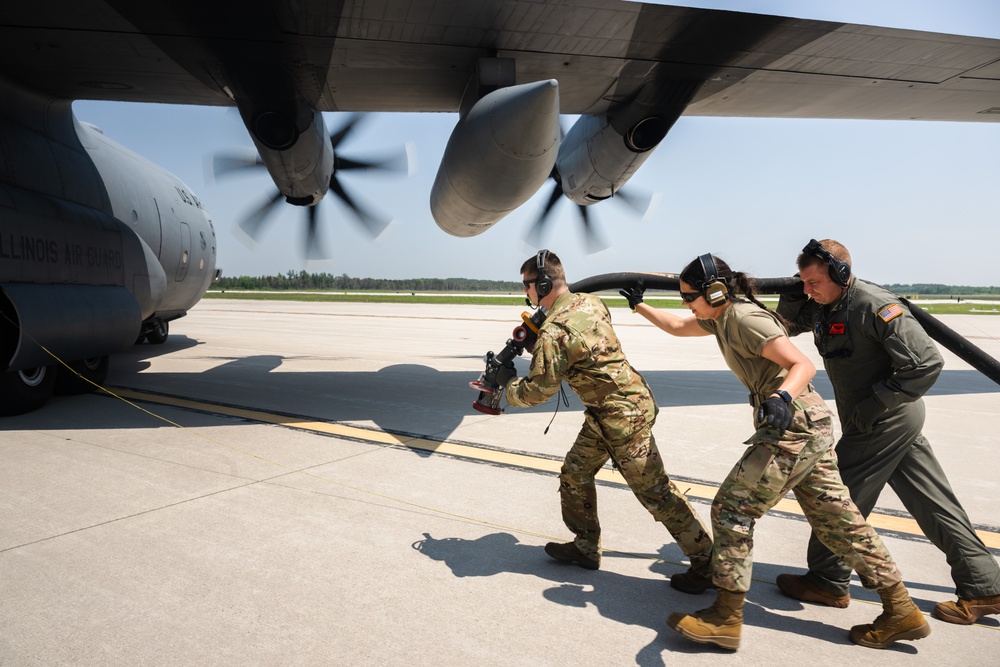
Photo By Senior Master Sgt. Scott Thompson | U.S. Air Force Staff Sgt. Isabella Davenport, fuels, Master Sgt. Joe Scurto and Staff Sgt. Tyler Peterson, aircrew, 182nd Airlift Wing, Illinois Air National Guard, pulls a fuel hose from a R-11 Mobile Fuel Vehicles Tank Truck towards a C-130H Hercules aircraft assigned to the 182nd Airlift Wing, Illinois Air National Guard, for hot refueling to support Sentry North 25 at Alpena Combat Readiness Training Center in Alpena, Michigan, June 5, 2025. Sentry North 25 is a joint military exercise that simulates realistic combat environments, including future battlefields. The training is customized to meet specific unit goals and provides advanced, joint exercises and unique opportunities not typically available at their home bases. (U.S. Air National Guard photo by Master Sgt. Scott Thompson) see less
| View Image Page
78th LRS powers air superiority with hot pit refueling
The 78th Logistics Readiness Squadron at Robins Air Force Base, Georgia, is ensuring aircraft readiness through hot pit refueling – a technique that reduces aircraft turnaround times by over 60%.
The process of refueling an aircraft while its engines are still running is a vital capability that allows aircraft to get back into the air faster, directly increasing air superiority during military air operations when minutes matter the most.
Senior Airman Austin Bates, 78th LRS fuels maintenance technician, has performed a multitude of hot refuels while deployed and to support missions at Robins AFB.
“The benefit of hot refueling is mainly to take out the maintenance side of it,” said Bates. “We want to get an aircraft down, refuel it while it’s still hot, and get it back up in the air as fast as we can.”
Typical refueling with engines turned off can take up to an hour due to the maintenance requirements that are necessary every time an engine is turned back on. With hot refueling, an aircraft can be on the ground for less than 20 minutes before returning to the air.
Bates says most of the work is done before the aircraft ever lands, with the 78th LRS and firefighters from the 778th Civil Engineering Squadron coordinating with the 402nd Aircraft Maintenance Group to stage the area and make sure the aircraft can be safely refueled.
“Hot refueling is a team effort,” said Manny Alam, 778th CES fire chief. “Fuels technicians, maintainers and firefighters are working in sync, communicating constantly and trusting one another’s expertise.”
While faster, the technique poses a higher risk of fires due to static electricity, equipment sparks, proximity to hot engines, and human error due to the high-pressure environment surrounding the process in deployed environments. These dangers mean that Airmen must adhere to strict safety procedures.
The 778th CES provides fire safety support during hot refueling operations with three firefighters and an Aircraft Rescue Firefighting apparatus carrying specialized firefighting agents, high‑capacity pumps and equipment designed specifically for aviation emergencies.
“If something goes wrong, such as a fuel spill igniting or an engine malfunction, the ARFF crew can respond instantly, minimizing danger and damage,” said Alam. “For the firefighters and LRS, this ensures mission success and more importantly, personnel safety.”
The 78th LRS runs through the hot refueling process several times a year, at least once for annual refresher training and throughout the year to support mission partners as they stop at Robins AFB.
“I like that it’s different from our typical mission of just going to a cold aircraft and refueling it in a normal way,” said Bates. “It’s essentially making aircraft push out faster to get to what they need to do to support the mission.”